Why I Take Creatine Monohydrate at 53
Why I Take Creatine Monohydrate at 53
And no, I am not trying to become a bodybuilder.
Last week, while writing She Always Made It Work, I found myself thinking about all the quiet ways my mom taught me to take care of myself without ever sitting me down and announcing that a life lesson was about to begin. She moved her body, took pride in how she looked, grew food, preserved food, stretched a dollar until it practically begged for mercy, and kept an entire household running with the precision of a military operation—albeit a military operation with better hair. She taught me that caring for yourself and the life around you was simply part of the job. I did not have the word “stewardship” for it then, but looking back, that is exactly what it was.
Now I am 53, and I have discovered that taking care of myself requires a slightly different strategy than it did at 23. At 23, I could stay up too late, eat something questionable from a drive-through, sleep folded like a lawn chair, and wake up ready to function. At 53, I can injure myself putting on a bra. I wish I were exaggerating. One enthusiastic reach behind my back and suddenly I am standing perfectly still, afraid to turn my head, wondering whether this is how the pioneers died.
So these days I think about strength differently. I think about muscle differently. I think about energy differently. I think about the woman I want to be at 63, 73, and 83, and I have become much less interested in simply making my body smaller and much more interested in keeping it capable. That shift is one of the reasons I started paying closer attention to something I had spent years mentally filing under Things Used by Men Who Carry Gallon Water Jugs Through the Gym.
Creatine.
More specifically—and I am going to keep saying this because it matters—creatine monohydrate.
Not a “Mega Shred Nuclear Performance Matrix.” Not a tropical-blue powder with seventeen ingredients and a warning label that makes your left eyelid twitch. Not a proprietary concoction containing three forms of creatine, two stimulants, an amino nobody asked for, and something called “Anabolic Thunder.” I am talking about plain creatine monohydrate, the decidedly unsexy form with the deepest research history behind it. At this point in my life, I am increasingly attracted to boring ingredients with receipts.
For years, I assumed creatine was basically a bodybuilder thing. You took it if you wanted enormous arms, a tiny tank top, and a compelling reason to grunt in public. I was not trying to bench-press a Buick. I was not preparing for a posing competition. I simply wanted to age well, stay strong, think clearly, maintain my independence, and preferably continue getting off the floor without first rolling onto all fours and pretending I had intended to inspect the carpet.
Then I started reading.
This is usually where the trouble begins.
The first thing that surprised me was how ordinary creatine actually is. Our bodies make it naturally, and we also obtain some from foods such as meat and seafood. Most of the body’s creatine is stored in skeletal muscle, where it participates in the rapid recycling of cellular energy. The technical conversation involves ATP, phosphocreatine, phosphate groups, and several words that can make perfectly intelligent people suddenly remember they need to switch the laundry. So allow me to explain it with the scientific language of my people: 1980s television.

Think of ATP as Crockett from Miami Vice. ATP gets the top billing. ATP has the white linen suit, the Ferrari, the dramatic stare across Biscayne Bay, and apparently enough confidence to wear loafers without socks. ATP is the immediate energy currency your cells use to do the work. But when demand suddenly rises and things get intense, Crockett cannot handle the entire drug cartel alone.
That is where creatine comes in like Tubbs.
Creatine helps support the rapid regeneration of ATP when energy demand spikes. In my deeply sophisticated Gen X interpretation of cellular biology, Tubbs is standing there saying, “I’ve got your back,” while Crockett continues looking fabulous in a pastel blazer. The actual biochemistry is more complicated, of course, but the basic idea is that creatine participates in a system that helps replenish immediately usable cellular energy. Apparently, even our cells understood in 1985 that nobody should be expected to do everything alone.
That made sense to me for muscle. Lift something heavy, sprint, climb stairs, shovel snow, chase a toddler who has just discovered permanent markers—energy demand rises quickly. Fine. I understood why athletes cared. But then I learned that researchers were looking beyond muscle, and that is when I disappeared headfirst into the rabbit hole with snacks and no immediate plans to return.
Because the brain needs energy too.
A lot of it.
Researchers have been asking what happens when the brain is under metabolic stress. What about sleep deprivation? Aging? Illness? Night-shift workers? Students cramming for exams? Parents who have not completed a full REM cycle since the Reagan administration? The emerging question is not simply whether creatine makes a healthy, beautifully rested person suddenly able to solve quantum physics before breakfast. It is whether supporting the brain’s energy system may matter more under certain conditions when demand is high and resources are strained.
That got my attention because, if we are being honest, how many people do you know who are beautifully rested, completely unstressed, metabolically serene, and floating through life like an Enya video?
Exactly.
One study that fascinated me looked at creatine during sleep deprivation. In a controlled experimental setting, researchers used a high single dose and observed changes in brain energy measures along with improvements in aspects of cognitive performance during sleep loss. Now, this is not permission to stay up all night watching The Golden Girls and wash down twenty-five grams of creatine with a Tab. Study conditions are not personal dosing instructions, and higher-dose brain research is still an active area of investigation. But the larger question grabbed me by the shoulders: could creatine become more relevant when the brain is stressed?
Suddenly, the old “five grams for everybody” conversation started feeling a little too tidy. Five grams for the twenty-five-year-old bodybuilder. Five grams for the fifty-three-year-old woman. Five grams for muscle. Five grams for the brain. Five grams for someone well rested. Five grams for someone running on four hours of sleep, menopause, two aging parents, a business, and the vague suspicion that she entered the kitchen for a reason. The human body has never shown much respect for tidy little universal rules, and researchers are still working out how dose, duration, body size, age, diet, tissue, and metabolic stress may influence response.
For general use, three to five grams a day is a familiar maintenance range, while other protocols use loading strategies or dosing relative to body weight. The part I find especially interesting is that brain-focused studies have sometimes used higher doses than the familiar gym scoop, because increasing brain creatine may not be exactly the same challenge as increasing muscle stores. That does not mean everyone should race into the kitchen and double or quadruple a dose. It means the science of dosing is far more interesting than I had realized.
And then the brain conversation became personal.
About a month ago, Mom started losing words. Not the ordinary “Why did I walk into this room?” experience that most of us have had since approximately 1997. This felt different enough that we noticed it. She would be talking and suddenly the word she wanted simply would not come, so more and more things became “thingy.” At first we laughed a little, because families sometimes laugh when something is uncomfortable and nobody wants to be the first person to say, “This scares me.”
But it did scare me.

Dementia is not an abstract word in our family. We have lived close enough to it that changes in memory and language get my attention very quickly. I found myself listening to Mom more carefully, noticing every missing word, and trying not to let my mind sprint ten years into a future none of us wanted to imagine. Anyone who has watched someone they love change because of dementia knows how one small moment can suddenly feel enormous.
Mom was already taking five grams of creatine monohydrate a day. Because I had been reading about creatine, brain energy, aging, and the possibility that brain-focused dosing may not be exactly the same conversation as muscle maintenance, I increased her from five grams to ten grams a day.
And within about three days, something changed.
The fog seemed to lift. Her conversation became clear again. The words were there. She said she had more energy. She could carry on a conversation without reaching for “thingy” every few sentences, and I remember listening to her speak and thinking, What in the world just happened? I cannot prove that increasing her creatine caused the change. I cannot tell you that creatine treats dementia, reverses cognitive decline, or guarantees that another person will have the same experience. My mother is a person, not a randomized controlled trial—although if sheer organization qualified someone to run a research institution, she would have federal funding and the cleanest laboratory in North America.
But I also refuse to pretend the timing did not get my attention.
It did.
A lot.
When I went back to the research, I found enough to make me even more curious. Studies and reviews have explored creatine monohydrate in relation to memory, attention, information processing, aging, and cognitively stressful conditions. The evidence is still developing, but there are positive signals worth following, and researchers are asking whether some people may respond differently depending on factors such as age, diet, baseline creatine status, dose, duration, and metabolic stress.
And this is where my brain works a little differently. I can ask, “What if it does nothing?” Of course I can. But I also want to ask, “What if it helps?” What if it helps someone maintain a little more strength? What if it helps an older adult support function? What if it helps a sleep-deprived brain handle a demanding day a little better? “We need more research” does not automatically mean “there is nothing here.” Sometimes it means we have found a door worth opening.
The mood research gave me another door.
Researchers have also explored creatine as a possible adjunct in depression, including alongside established treatment. That does not mean anyone should throw away an antidepressant, cancel therapy, and replace professional care with a scoop of white powder from the pantry. Depression is serious, treatment is personal, and “I saw it on a wellness blog” is not a psychiatric care plan. But am I fascinated that researchers are asking whether brain energy metabolism may be relevant to mood and whether creatine could play a supporting role for some people?
Absolutely.
Because once again, I find myself thinking about energy. Muscle energy. Brain energy. Stress. Sleep deprivation. Mood. Aging. The more I learn, the less creatine looks like a supplement exclusively for twenty-two-year-old men taking mirror selfies between sets. It starts looking like a naturally occurring compound involved in cellular energy that researchers are investigating across a much broader landscape.
Then there is the women’s conversation, and this is where I would like a brief word with the marketing department of the last forty years. Women of my generation were taught to fear getting bigger with the kind of intensity usually reserved for quicksand, spontaneous combustion, and whatever was apparently lurking in the Bermuda Triangle. We were supposed to eat tiny yogurts, order dressing on the side, do enough cardio to qualify for interstate travel, and pursue a body with roughly the same muscle mass as a decorative throw pillow. Nobody sat most of us down in our thirties and said, “By the way, there may come a time when preserving muscle, strength, power, and function becomes a much bigger deal than fitting into the jeans you wore before you had children.”
That conversation would have been useful.
Instead, we got SnackWell’s cookies and a ThighMaster.
Then perimenopause arrives, sometimes quietly and sometimes like The A-Team crashing a van through the front wall of your endocrine system. Sleep may become less reliable. Recovery can feel different. Body composition may begin changing even though you are standing in your kitchen insisting you have not done anything differently. Your brain can occasionally behave as though somebody changed the password overnight, and there you are staring directly at a person you have known for fifteen years while your mind offers absolutely nothing except, “You know…her…with the hair.” Meanwhile, everyone tells you to manage stress, prioritize sleep, eat more protein, lift heavy things, get your steps, meditate, hydrate, nurture your relationships, and perhaps develop a meaningful morning practice before sunrise. Wonderful. I will pencil that in between the hot flash and my 3:17 a.m. appointment with the ceiling.
This is one reason the creatine monohydrate conversation becomes so interesting to me in midlife. Creatine is not estrogen. It is not hormone replacement therapy. It is not a treatment for hot flashes, and I am not going to tell you that one scoop will march into your endocrine system like Olivia Newton-John in a headband and restore order by lunchtime. But researchers are paying more attention to creatine across female life stages and to the relationship among hormones, creatine metabolism, cellular energy, muscle, and brain health. After decades of women being treated like smaller men with more complicated paperwork, I am delighted someone is finally asking better questions.
The muscle piece alone deserves our attention. As women move through the menopause transition, we are also moving into years when preserving lean tissue, strength, and physical function becomes increasingly important. That does not mean every woman wakes up on her fiftieth birthday and loses a bicep in the night. Biology is more complicated than that. But midlife is an excellent time to become much more intentional about resistance training, adequate protein, recovery, and muscle—not because we are trying to become bodybuilders, but because muscle is part of how we keep doing our own lives.
And this is where creatine monohydrate becomes a fascinating partner to the conversation rather than the star of a one-woman show. The practical story is not “take creatine and sit very still.” Research in older adults and postmenopausal women has explored creatine, often alongside resistance training, with encouraging findings in areas such as strength, lean tissue, and aspects of physical function, though results depend on the study and protocol. A small 2025 study that included peri- and postmenopausal women reported improvement in a lower-body strength measure, and the perimenopausal subgroup also reported improved sleep quality.
Did I pause at the word sleep?
Ma’am, I nearly pulled the car over.
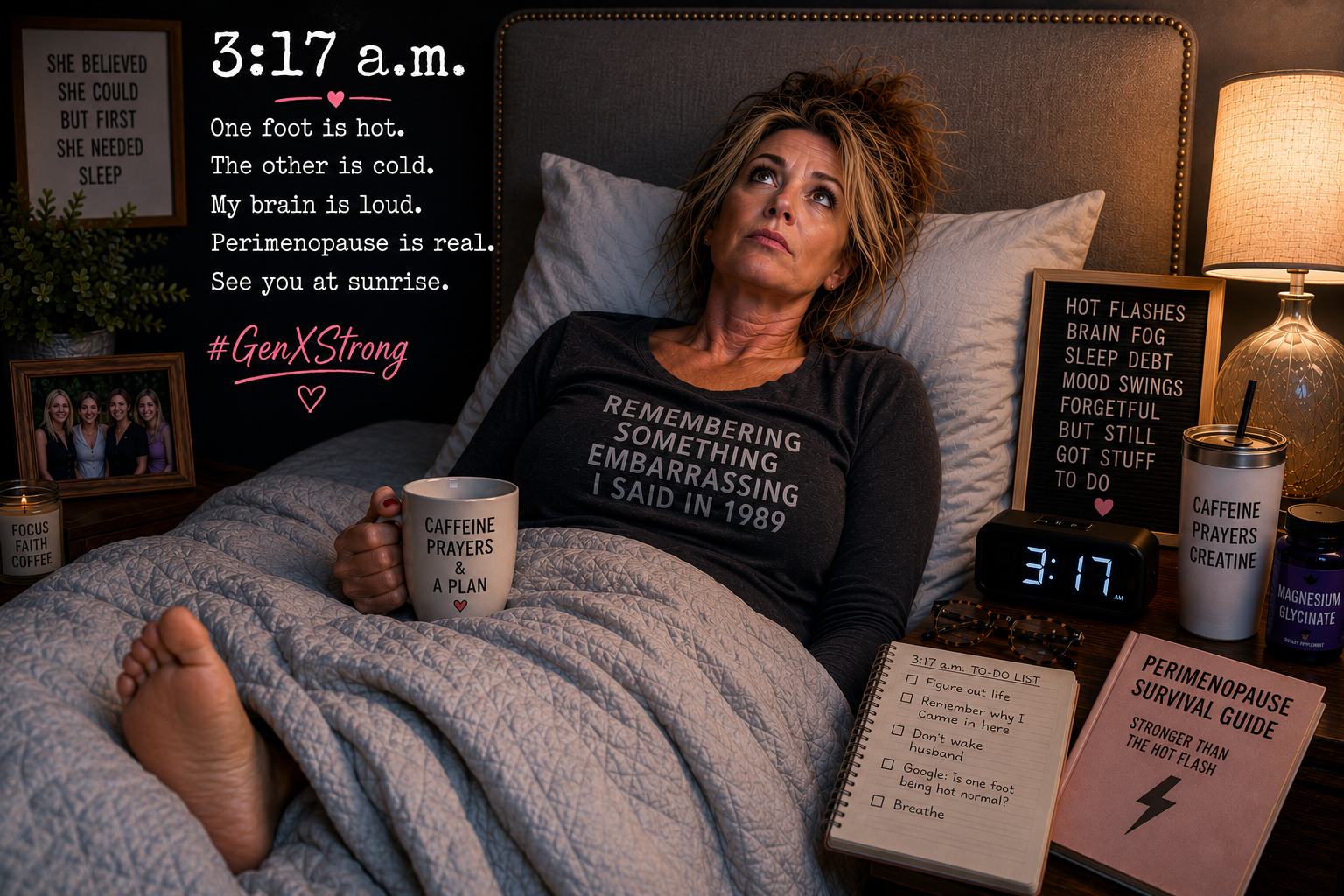
Because if you have never experienced perimenopausal sleep, allow me to explain. You can be exhausted at 9:00 p.m., mysteriously alert at 11:30, asleep at midnight, awake at 2:47 because one foot is hot, back asleep at 3:26, awake again at 4:06 thinking about something embarrassing you said in 1989, and then expected to greet the morning with gratitude and cortisol management. So when researchers find even an early signal involving sleep quality in perimenopausal women, I am interested. Not convinced beyond all doubt. Not ordering a marching band. Interested. There is a difference, and curiosity has always been where I begin.
Then there is the brain. Ah yes, the perimenopausal brain—the place where I can remember every word to Pour Some Sugar on Me but cannot remember why I opened the refrigerator. Women commonly report brain fog during the menopause transition, and researchers are increasingly interested in the intersection of hormones, sleep, mood, cognition, and brain energy metabolism. Creatine monohydrate is not a proven cure for menopausal brain fog, and I will not pretend that it is. But because creatine participates in cellular energy systems in both muscle and brain, I think this is a question worth following closely.
And frankly, midlife gives the brain plenty to deal with even before we start discussing cellular energy. Disrupted sleep. Aging parents. Changing bodies. Careers. Relationships. Children leaving home—or children who apparently have no plans whatsoever to leave home—and the realization that we are now the adults everyone calls when something goes wrong. Add fluctuating hormones to that particular circus and suddenly forgetting why you opened the refrigerator feels less like a personal failure and more like your brain filing a formal grievance with management.
What I love most about this conversation is that it gives women a different way to think about aging. Perimenopause is so often framed as a list of things we are losing: estrogen, sleep, muscle, bone, patience, and occasionally the ability to tolerate anyone chewing loudly. But what if this chapter is also the moment we become more intentional about what we are building? More strength. More muscle. Better support for our brains. Better recovery habits. More protein. More resistance training. More honest conversations about mood and sleep. Maybe the goal is not to white-knuckle our way through menopause while trying desperately to keep our bodies looking thirty-five. Maybe the goal is to build a body and brain capable of carrying us powerfully into the next thirty years.
At 53, that is the conversation I want.
Not how little can I weigh.
How much life can I keep living?
I want to carry my own groceries, lift my own suitcase, climb stairs, garden, travel, and get down on the floor and get back up without needing a Life Alert button, a pulley system, and Tubbs arriving in a speedboat. And yes, I still want to look good. We are allowed to say that. Somewhere along the way, women are expected to pretend that once we become interested in health, we have transcended vanity entirely and no longer care whether our arms look fabulous in a sleeveless shirt.
Please.
I contain multitudes.
I would like strong bones, capable muscles, a sharp brain, good energy, healthy skin, and excellent lighting.
This is The Alchemy of Beauty, not a monastery.
Then there is the water-retention myth, which has probably scared countless women away before they ever looked at the research. Creatine can shift water, particularly early on or with aggressive loading strategies, but the story is more nuanced than “creatine makes you puffy.” Creatine is osmotically active, and some of the water associated with creatine storage is within muscle tissue. That is not the same thing as suddenly gaining body fat. The bathroom scale may move for some people, especially early on, but at 53 I am trying very hard to stop treating a small electronic rectangle on the floor like it has been appointed Supreme Court Justice of My Worth.
The scale may submit evidence.
It no longer gets the final ruling.
And while we are dismantling myths, we need to talk about kidneys. Creatine supplementation can affect serum creatinine, a blood marker commonly used when estimating kidney function, because creatinine is related to creatine metabolism. That can complicate interpretation of lab results without automatically meaning creatine has damaged healthy kidneys. This is exactly why people should tell their healthcare professionals what supplements they take instead of acting like the vitamin cabinet is classified government information.
Context matters.
That does not mean every person on Earth should take creatine without thought. If you have kidney disease, significant medical conditions, medication concerns, are pregnant or breastfeeding, or are considering higher doses for a specific reason, talk with a qualified healthcare professional who understands your health history. And if someone develops sudden trouble speaking, confusion, facial drooping, weakness, or other acute neurological symptoms, that is not a “let’s try creatine and see what happens” moment. That can be an emergency.
Curiosity and common sense are allowed to live in the same house.
So What Creatine Do I Actually Take?
After all this research, rabbit-holing, and turning cellular bioenergetics into an episode of Miami Vice, the obvious question is: Okay, but what do you actually take?
I take SPRT Creatine by Frequense.
It is an unflavored creatine monohydrate, which matters to me because—as I said earlier—I am increasingly attracted to boring ingredients with receipts. I was not looking for a neon pre-workout concoction called Menopause Thunder 5000. I did not need artificial fireworks, a proprietary mystery matrix, or a scoop of something electric blue that makes me feel as though I should alert poison control before opening the lid. I wanted creatine monohydrate. Clean. Simple. No nonsense.
And I am picky about the word clean, because the supplement industry can occasionally use it with all the precision of a toddler describing where they put your car keys. According to the product’s quality information, the creatine I use is third-party tested and associated with quality and certification standards including NSF, organic, kosher, halal, and SQF; it is also described as heavy-metal free, gluten free, sugar free, and soy free. Before I publish those exact credentials, I am going to make sure I have the wording precise because there is a difference between a finished product being certified, a facility being certified, and a product being tested to a particular standard. But the bigger point is simple: if I am going to take something every day—and especially if I am going to give it to my own mother—I care deeply about what is actually in the container.
There is another reason this particular product caught my attention. SPRT is also marketed as frequency charged and tuned with harmonic frequencies. If you have been around me for more than eleven minutes, you already know I am curious about energy, frequencies, bioenergetics, and all the strange little intersections where established science, emerging ideas, and my tendency to disappear into a rabbit hole meet for coffee. That part interests me too.
But credibility matters more to me than making a flashy claim, so I want to be clear: the large body of research I have discussed throughout this article is research on creatine monohydrate itself. I am not going to borrow decades of creatine research and pretend it automatically proves every additional claim made about one particular branded product. Those are different conversations. I can be fascinated by both without pretending they are the same thing.
What I can tell you is that this is the creatine I personally take. It is the one sitting in my kitchen. It is part of my own routine. It is the one I chose after looking at what matters to me, and it is the one I am comfortable sharing when somebody inevitably messages me after this article and says, “Okay, Thingy McThingerson, WHICH ONE DO YOU TAKE?”
Fair question.
This one.
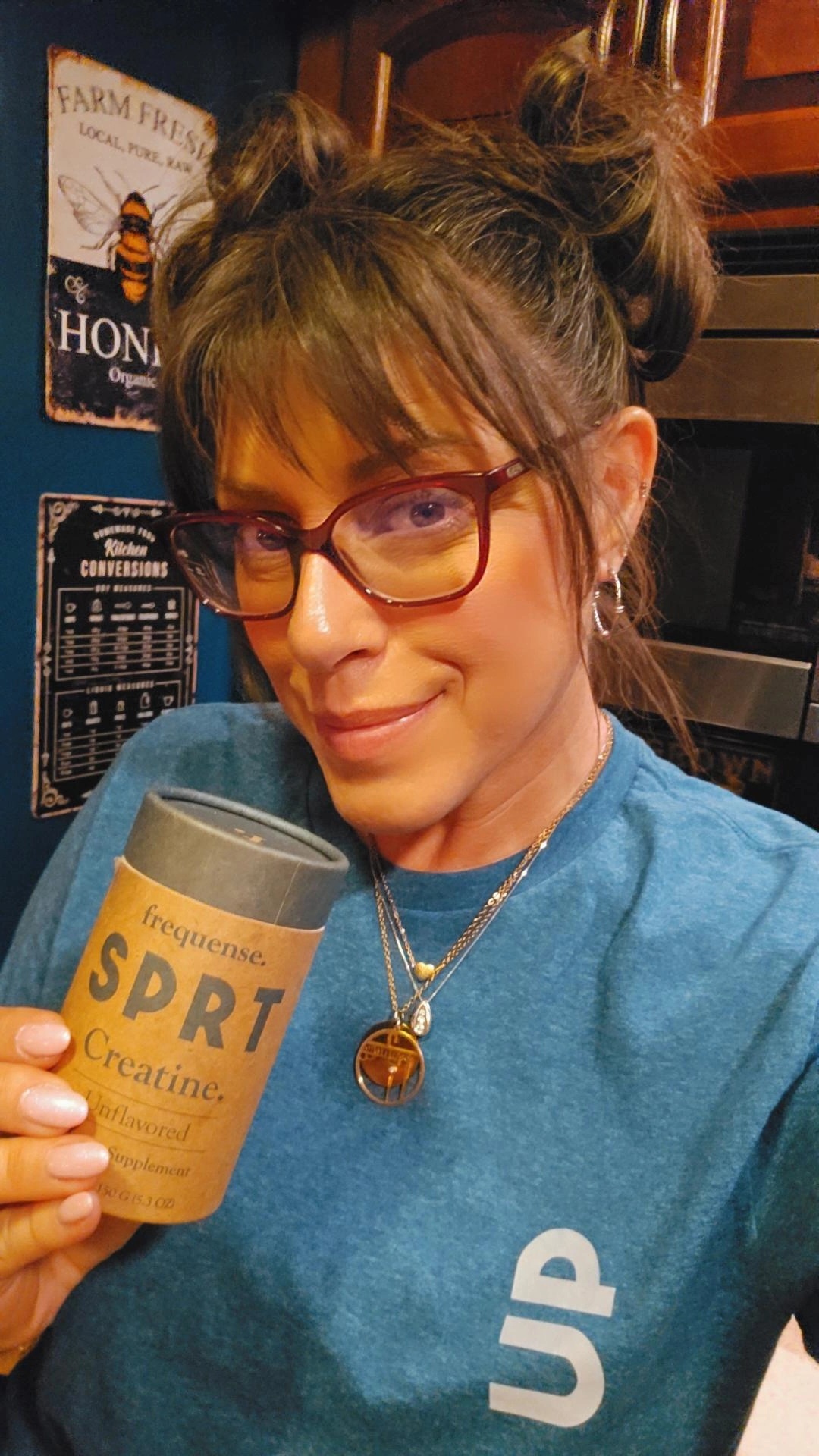
Want to meet my Tubbs? You can see the exact creatine I take here: SPRT Creatine
Affiliate disclosure: I am an affiliate, which means if you purchase through my link, I earn a commission. The price is fixed; you do not pay more for using my link. I share it because this is the product I personally use, and I appreciate the support when someone chooses to order through me.
So why do I take creatine monohydrate at 53?
Because I am thinking about my future self. I am thinking about muscle, yes, but also about energy, resilience, healthy aging, and the growing research around the brain. I am thinking about the fact that women spent decades being encouraged to disappear when perhaps we should have been learning how to become stronger. I am thinking about my mom, about “thingy,” and about the change we observed after her intake went from five grams to ten. I cannot promise anyone else the same experience. But I can tell you that it made this research deeply personal for me.
And I keep coming back to last week’s blog.
Mom taught me that taking care of yourself is not vanity. It is stewardship. Her version involved movement, real food, resourcefulness, consistency, and somehow locating dust particles invisible to the naked eye. My version includes many of those same lessons, plus resistance training, protein, research papers, podcasts, and a scoop of creatine monohydrate that has absolutely no idea how many years I spent assuming it belonged exclusively to men with necks the size of tree trunks.
At 53, I am not trying to become twenty-five again.
I already was twenty-five.
She was an adorable chaotic mess.
She also made questionable decisions.
I am trying to become a strong, curious, capable older woman. I want enough muscle to support my independence, enough energy to keep participating fully in my own life, enough humility to keep learning, and enough humor to survive the fact that I can now injure myself putting on undergarments.
Maybe future research will help us get far more specific about who benefits most, how much, for what goal, and under what circumstances.
I hope it does.
Because I am no longer interested only in asking, “What if it doesn’t?”
I also want to ask:
“What if it helps?”
That question is why I keep reading. It is why I keep learning. It is why I keep trying to understand the body I live in now instead of mourning the one I had thirty years ago.
And it is one of the reasons I take creatine monohydrate at 53.
Not because I am trying to become someone else.
Because I would very much like to keep being me.
For a long, long time.