When Did Sleep Become Something We Had to Hack?
Hormones, circadian rhythms, magnesium, menopause, one strategically uncovered foot—and our increasingly complicated relationship with going to bed
I have never understood people who can simply decide to go to sleep. You know the ones. They look at the clock, announce that they're tired, go to bed, close their eyes and apparently that is the end of the story. I've always found this slightly suspicious, mostly because sleep never worked that way for me. Even as a child, bedtime was less of an event and more of a suggestion.
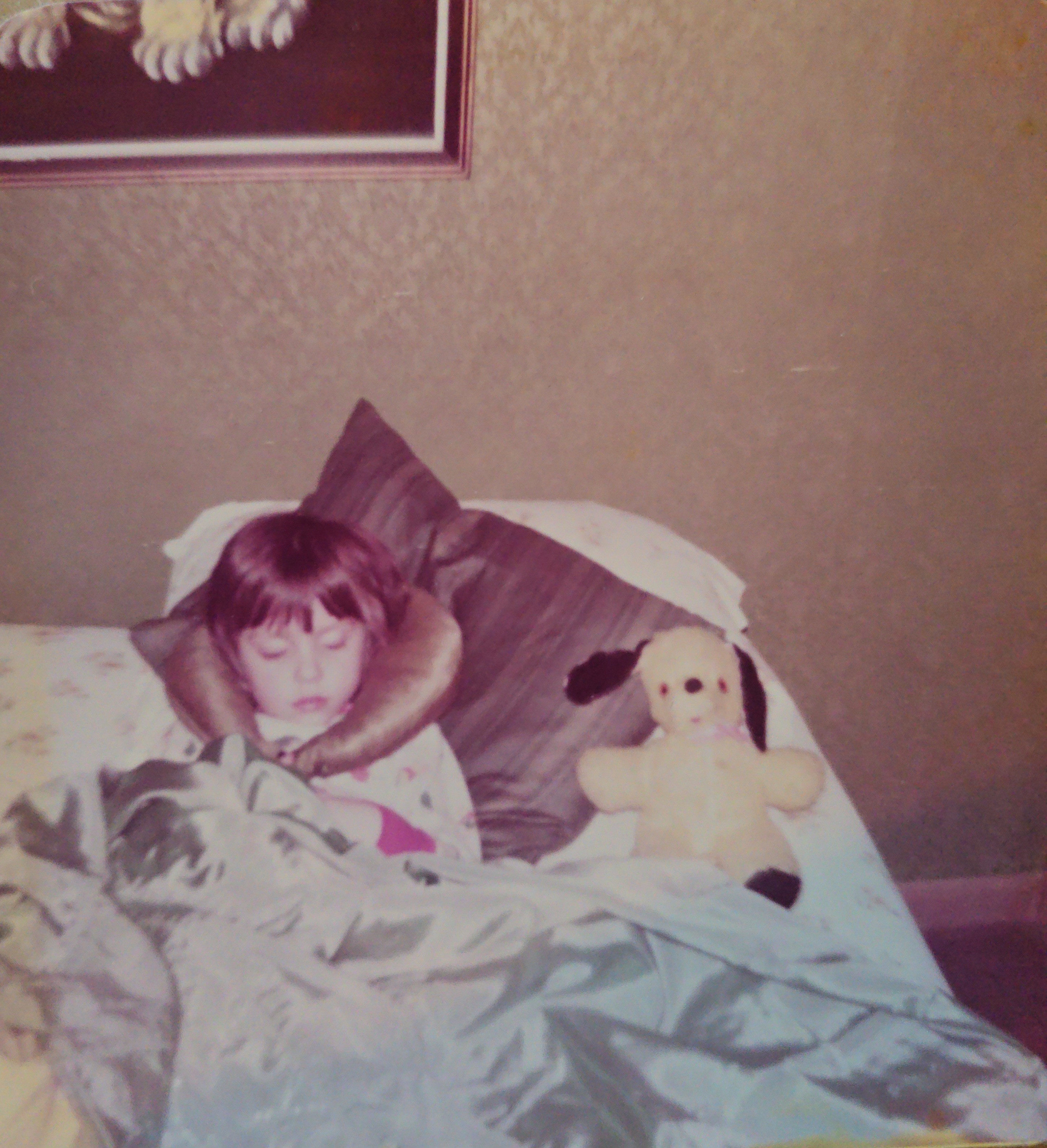
My mom would come into my room late at night to check on me, probably expecting to find her daughter peacefully asleep, and instead I would be sitting there writing, embroidering, sewing or doing whatever other project had captured my attention. She would just look at me and shake her head, and honestly, I didn't have a good explanation for her because I wasn't deliberately trying to stay awake. I simply wasn't asleep. There were times when I would get two or three hours of sleep and somehow get up and function the next day as though this were a perfectly reasonable way for a human being to live. Looking back now, I have no idea how I did it. Give me two or three hours of sleep today and I cannot guarantee the quality of anything I say, do or agree to before noon.
The strange thing was that I wasn't incapable of sleeping. Apparently I was simply incapable of sleeping when sleep was the assigned activity. If I became genuinely exhausted, all bets were off, and I discovered this rather spectacularly years ago when I was in Las Vegas with my nail competition team. Beauty trade shows are exhausting under ordinary circumstances. You're walking all day, talking all day, surrounded by noise and people and products and demonstrations, and when you add the adrenaline and concentration of competing on top of it, eventually your body sends a very clear message that the festivities are over whether everybody else has received that message or not. One evening after dinner, the girls wanted to wander around the casino and play the slots. I wanted my bed. We had promised one another that we would stick together, though, so I stayed with them, sat down beside one of my friends at a slot machine and tried valiantly to remain a participating member of the group.
If you've ever been inside a large Las Vegas casino, you already understand why what happened next was ridiculous. Casinos are not environments designed to encourage peaceful slumber. There were lights flashing everywhere, machines chiming, bells ringing, people talking, music playing and who knows how many electronic noises announcing that somebody, somewhere, had just won something. It was sensory overload in every direction, and right there in the middle of it, sitting upright beside a slot machine, I fell asleep. Completely asleep. People spend hundreds of dollars trying to create the perfect sleep environment with blackout curtains, white-noise machines and carefully controlled bedroom temperatures, and apparently all I needed was total physical exhaustion and several thousand flashing lights. That's a whole new level of tired.
That contradiction followed me through much of my life. Put me in a quiet bedroom when I was supposed to sleep and my brain could suddenly become fascinated by every subject known to mankind. Exhaust me enough, though, and apparently you could prop me against a slot machine on the Las Vegas Strip and I would figure it out. Somewhere in my mid-40s, around the time perimenopause began making itself known, even that familiar pattern started changing. I was still perfectly capable of having trouble falling asleep, but my sleep schedule became more unpredictable and my body seemed to be rewriting rules I'd lived with for decades. I didn't necessarily recognize all of it as perimenopause at the time. Like a lot of things in midlife, sometimes you don't realize you've entered a new chapter until you're several pages into it and wondering who changed the plot.
Sleep problems are extremely common during the menopausal transition, but what I find fascinating is that there isn't one tidy explanation for them. Hormonal changes matter, but so can hot flashes and night sweats, mood and stress, aging, changes in circadian timing, restless legs, sleep apnea and a whole collection of factors that can overlap with one another. That makes much more sense to me than the simplistic version of menopause we're often handed, where estrogen goes down, women stop sleeping and apparently that's the end of the investigation. The female body has never struck me as particularly interested in doing anything that simply.
Temperature alone deserves its own investigation, because women have been practicing an extraordinarily sophisticated form of nighttime thermoregulation for generations without receiving nearly enough scientific recognition for it: the one-foot-out method. You know exactly what I'm talking about. The rest of your body is comfortably tucked beneath the covers, but one foot must remain exposed to the atmosphere. If you become chilly, the foot returns. If things heat up again, it is redeployed. On particularly difficult nights you may graduate to an entire leg, but that's advanced-level temperature management and should probably require certification. Then perimenopause comes along and the whole operation becomes considerably more complicated because your internal thermostat occasionally behaves as though someone handed the controls to a toddler. One minute the blankets are perfect, the next they are an instrument of torture, and five minutes after throwing them off you're cold and pulling them back on again. Foot out, foot in, covers off, covers on. Somehow nobody mentions this part when we're young.
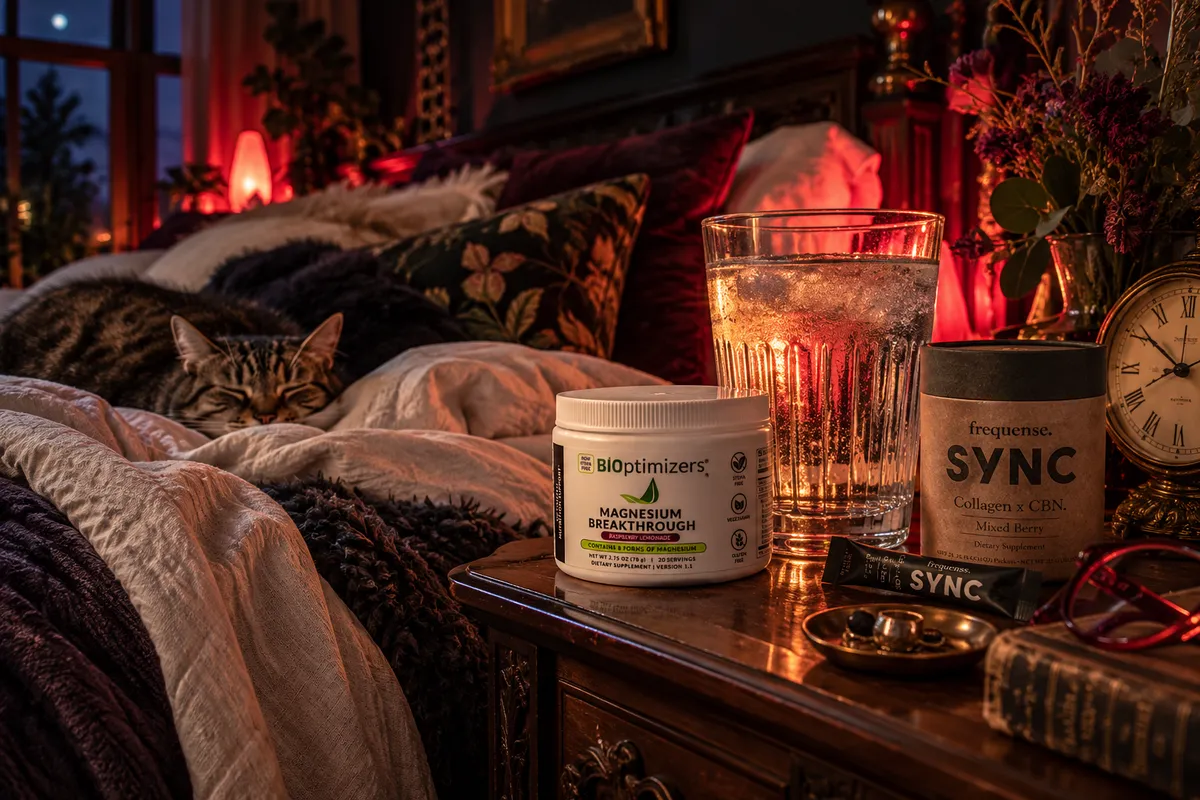
The more I thought about all of this, the more I began wondering when something as ancient and biologically fundamental as sleep became something we felt we had to hack. We have magnesium and glycine and GABA, CBD and CBN, herbal teas and tinctures, sleep trackers and smart rings, blackout curtains, white-noise machines, cooling mattresses, weighted blankets, red lights, amber glasses and apps that monitor us all night and then greet us in the morning with a numerical assessment of how successfully we were unconscious. I find that last one particularly funny. You can wake up thinking you slept pretty darn well, look at your device and discover that you received a sleep score of 62, and suddenly you're tired. Apparently even sleeping now comes with a performance review.
There is actually a name researchers have used for the strange place this can lead us: orthosomnia, an unhealthy preoccupation with achieving perfect sleep data, particularly when wearable trackers become part of the anxiety around sleep. I couldn't help laughing when I learned that, because it feels like such a perfectly modern problem. We have developed technology sophisticated enough to tell us more about our sleeping bodies than our grandparents could ever have imagined, and some of us have responded by lying awake worrying about whether we're getting enough deep sleep.
And yet beneath all of our technology is a system that is unimaginably older than any of it. For most of human history, nobody needed an app to tell the body that evening was approaching because the entire world changed around them. Morning became bright, daylight remained bright, evening became dimmer and warmer, and then darkness came. Our circadian system evolved within that repeating pattern, and light remains one of the strongest environmental signals telling the brain where we are in the roughly 24-hour cycle. Specialized cells in the eye respond to light and communicate with the brain's central circadian clock, helping coordinate everything from alertness to hormone timing. Short-wavelength, blue-enriched light is particularly effective at influencing this system, which doesn't mean blue light is bad. Daylight contains plenty of it, and we need strong daytime light cues. The oddity is that we've become extraordinarily good at extending daytime long after the sun has disappeared.
God created a world with a rhythm already built into it—light and darkness, morning and evening, activity and rest—and then we humans discovered electricity and apparently decided that 10:30 at night should look like high noon. We turn on bright overhead LEDs, watch a giant glowing television while holding a smaller glowing phone in our hands, and then wonder why our bodies don't immediately understand that we're winding down for the evening. That was what made me curious about amber and red lenses in the first place. I had heard the claims about wearing them at night to reduce blue-enriched light, and when I went looking I was pleasantly surprised to discover that the idea wasn't pulled entirely from the wellness ether. There are small randomized studies, including research involving people with insomnia, that have found improvements in some sleep measures when participants wore amber blue-blocking lenses before bed, although the overall body of research is still mixed and the glasses themselves vary considerably in what wavelengths they actually filter.
I actually like that answer better than being told I've discovered another miracle. It leaves us with something much more useful: perhaps the point isn't that everyone needs a special pair of glasses; perhaps the point is that evening should look like evening. Maybe that means amber lenses. Maybe it means turning off the bright overhead lights and using warmer lamps. Maybe it means not holding your phone six inches from your face while reading something infuriating five minutes before attempting to sleep. It is less glamorous than buying another gadget, certainly, but biology has never seemed terribly concerned with whether its solutions photograph well for Instagram.
And speaking of things that don't photograph particularly elegantly, we need to discuss my bed.
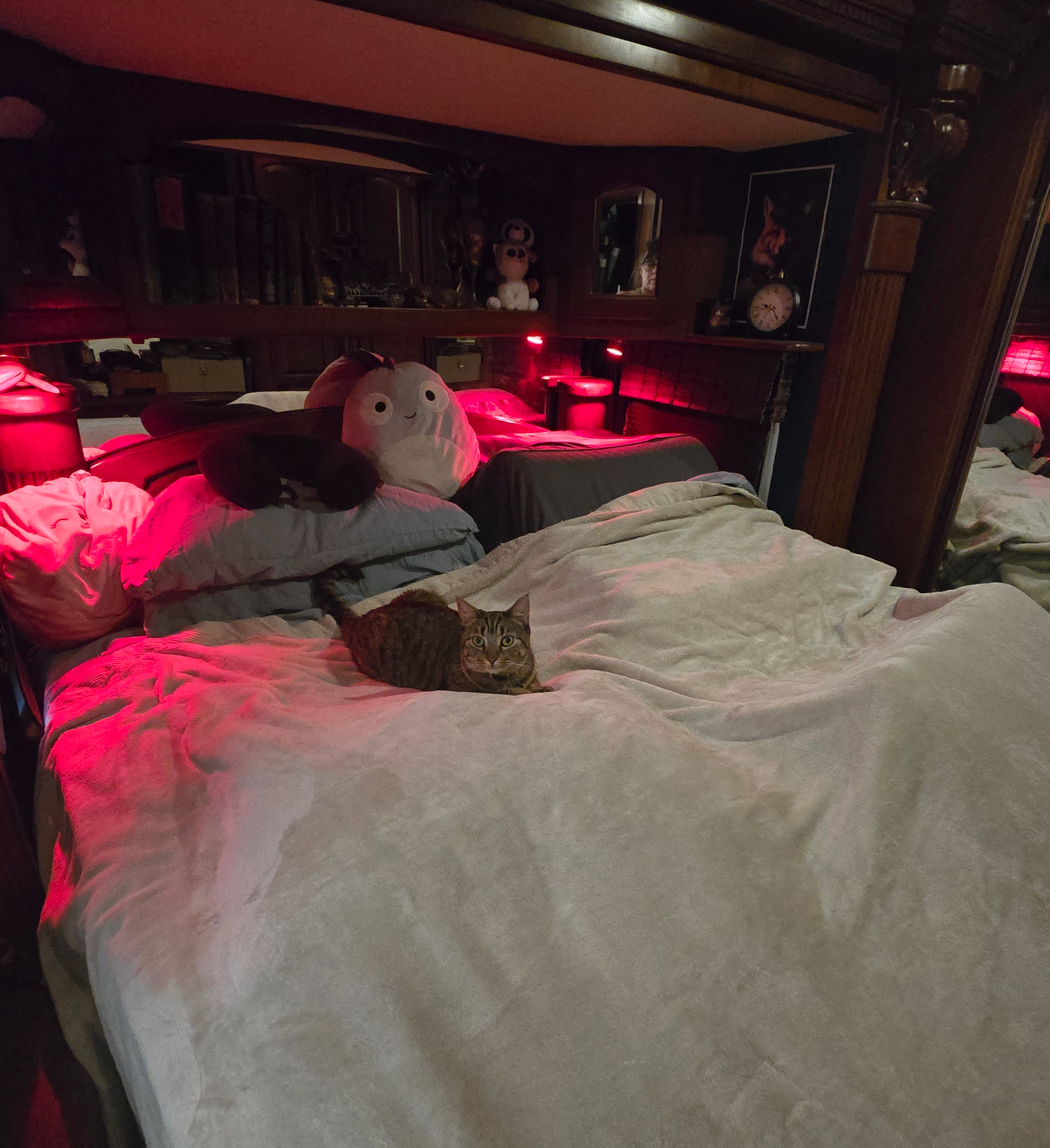
I realize there are people who purchase a mattress, place two pillows at the top of it and consider the sleeping arrangements complete. I admire these people from afar because my bed looks as though I'm either preparing to sleep or recovering from a complicated orthopedic procedure. Over the years I have accumulated a feather pillow, a contour pillow, an angled triangular pillow with a neck roll for when I'm sitting up watching television or working on the computer, another triangular pillow for underneath my knees, and another foam pillow because when I sleep on my side I need something between my knees or my body immediately files a complaint. Then there's the travel pillow, which makes regular appearances whenever my neck hurts because sometimes that little bit of support is exactly what I want.
And then there are the two Squishmallows, because apparently the other pillows were not enough. If I'm sleeping on my side, having a pillow between my knees is only half the operation; I also need something beneath my upper arm to hug because otherwise my shoulder and arm start hurting, so somewhere along the way two adorable stuffed creatures were promoted into my orthopedic support staff. I started listing all of this recently and laughed so hard when I realized I don't know how I could ever have a romantic relationship because, quite frankly, there is no room. Where would he go? The position has been filled. I suppose I could explain that his side of the bed is currently occupied by a foam pillow, two Squishmallows and a triangular wedge with seniority, but I don't imagine that's the welcome anyone dreams of receiving. And that's assuming Reba hasn't gotten there first. I don't even know why I bother putting the bed back together every day because she immediately begins rearranging it according to her specifications known only to her.
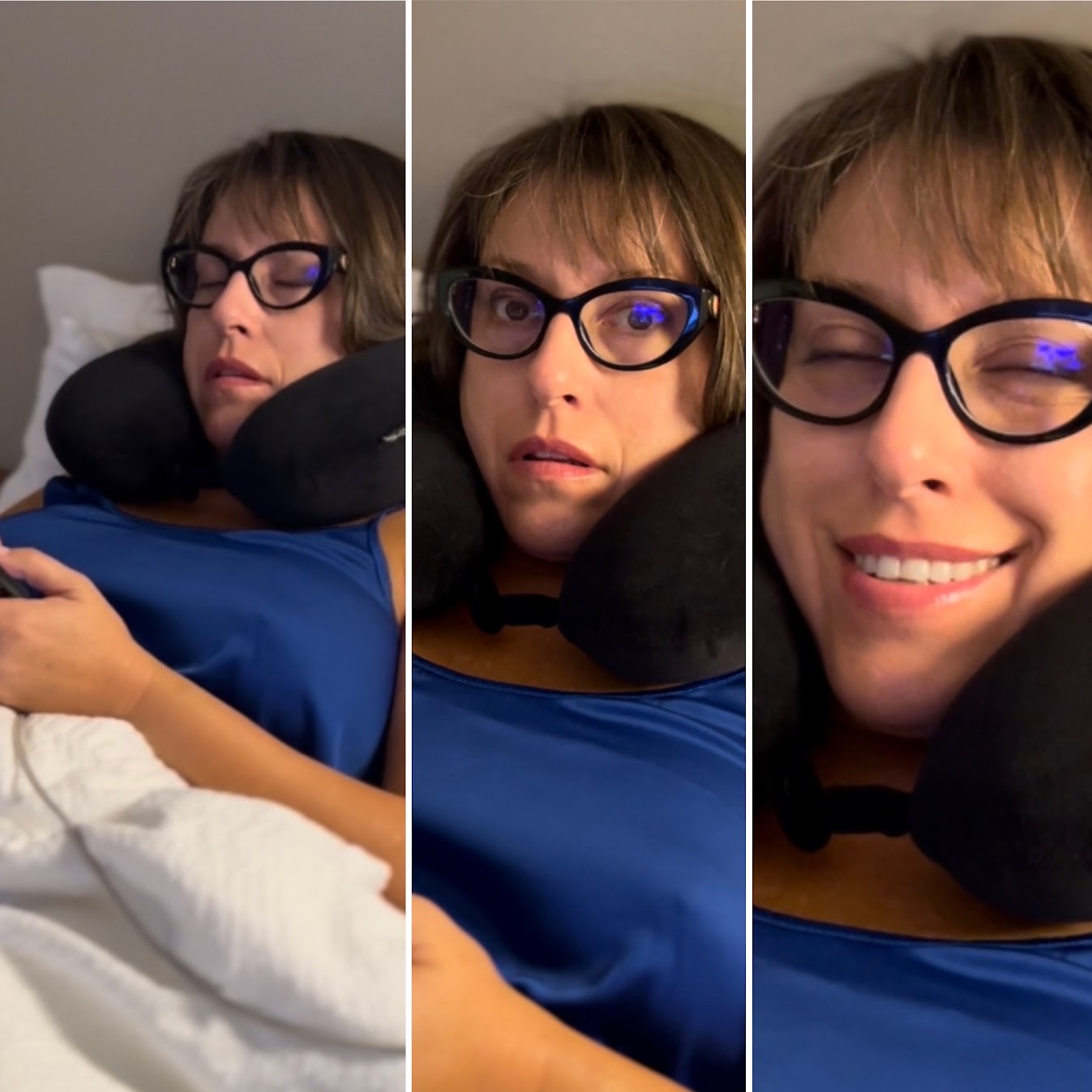
The best part is that I have photographic evidence suggesting none of this is new. There are pictures from my nail-team traveling days where I'm sitting upright in bed, propped against three pillows, travel pillow around my neck, phone still in my hand, completely asleep. Apparently once I achieved the correct geometric configuration, my body wasn't about to waste the opportunity. And remember that picture of little me you saw earlier, lying there on a wad of pillows with a travel-style pillow already wrapped around my neck? Apparently this wasn't something I developed with age. The pillow fort just got bigger. I arrived on this earth with strong opinions about cervical support and have apparently spent the decades since expanding the research.
Once I stopped laughing about my pillow fortress, though, it raised another question: how much does the physical environment we're sleeping in actually matter? And that question sent me somewhere I wasn't expecting—to the sheets.
I've become increasingly interested in what we put against our bodies all day and all night, and somewhere along the way I started hearing people talk about natural fibers differently than I had before. Linen, cotton, wool and silk—materials humans have been wearing and sleeping in for a very long time—were being compared with polyester and other synthetics, and one of the claims that kept appearing was that different fabrics have different “frequencies.” Linen in particular is often given extraordinarily high numbers online, while polyester is assigned very low ones, along with all sorts of claims about what those frequencies supposedly do to the human body. You know me well enough by now to know what happened next. I couldn't just hear that and leave it alone. I wanted to know where the numbers came from, what exactly had been measured, what instrument had measured it, whether the work had been published and, most importantly, whether anybody had demonstrated that whatever was being measured actually changed human physiology or sleep.
This is where the internet can become a very strange place, because once a number gets repeated often enough, it begins to look like a scientific fact even when nobody can seem to find the original science underneath it. So far, I have not been able to find credible peer-reviewed human research validating the specific numerical “healing frequency” values commonly assigned online to linen, cotton and polyester, nor research showing that sleeping on a fabric because it supposedly vibrates at a particular frequency improves sleep or health. That doesn't mean textiles are biologically irrelevant, nor does it mean science has investigated every possible interaction between our bodies and the materials around them. It simply means I haven't found research that would make me comfortable putting one of those frequency charts here and calling those numbers established science.
What I did find was more interesting anyway. There is sleep research involving different textile fibers, although there isn't a mountain of it. A recent systematic review found only nine eligible studies involving materials such as cotton, polyester, wool, down and linen, but some suggested that fibers and bedding systems can affect thermal comfort and sleep under certain conditions. One study in warm conditions reported fewer awakenings and some better sleep measures with a linen-based bedding system than with a cotton/polyester setup, although the systems differed in enough ways that we can't simply crown linen the champion of sleep and send everyone shopping for new sheets.
What makes intuitive sense to me is that a bed is really its own little climate. We climb underneath layers of fabric and create this warm pocket of air between our bodies, pajamas, sheets, blankets and mattress. Those materials differ in the ways they handle heat and moisture, and suddenly choosing sheets isn't only about whether something feels luxurious when you run your hand over it at the store. If you're already spending half the night performing the one-foot-out maneuver because your internal thermostat has become temperamental, what surrounds your body for seven or eight hours could matter simply because being too hot, clammy or uncomfortable is not exactly conducive to peaceful sleep.
I've also become more conscious of synthetic materials for another reason. Polyester is a synthetic polymer, and synthetic textiles can release microscopic plastic fibers through washing, drying and ordinary use. Natural textiles shed fibers too, so “microfiber” doesn't automatically mean plastic, and none of this allows me to leap from “polyester can shed microplastic fibers” to “polyester sheets cause insomnia.” Still, when I think about how many hours of our lives are spent wrapped in bedding, I don't think it's unreasonable to care about what that bedding is made of. I don't need to prove something is poisonous before I'm allowed to prefer the alternative. I like linen and cotton, appreciate how they feel and breathe, and increasingly prefer natural fibers where they make sense for me.
And somewhere in that investigation I realized how often temperature kept appearing. It was there in menopause, in the one-foot-out method and in bedding, and then, somewhat unexpectedly, it appeared again when I started reading about glycine. There are a handful of small human studies suggesting that taking glycine before bed may improve certain subjective aspects of sleep or next-day fatigue, and although the research isn't large enough for me to call glycine an established insomnia treatment, the proposed physiology caught my attention. Researchers have investigated its relationship with thermoregulation, peripheral blood flow and the drop in core body temperature associated with sleep. There was temperature again. Apparently my foot sticking out from under the covers had wandered into a much larger biological conversation.
My nighttime experiments also led me to ingredients that appear again and again in sleep-support formulas, including several that are in SYNC, which I use every day. Magnesium, GABA, CBD and CBN don't all approach sleep in the same way, and that's actually what interests me about seeing them together. They interact with different systems and pathways involved in nervous-system activity, relaxation and the sleep-wake cycle, and the research around each is at a different stage.
Magnesium is probably the most familiar of the group. It's an essential mineral involved in hundreds of reactions throughout the body, including normal nerve and muscle function, and it has been studied in connection with sleep for years. Clinical trials haven't produced one perfectly consistent answer about magnesium supplementation and insomnia, which isn't terribly surprising when you consider the different forms, doses and populations being studied. That doesn't erase the physiology of magnesium or the experiences of people who find it helpful; it means sleep is complicated enough that one nutrient isn't going to be a universal answer for every person with every type of sleep problem. I think that distinction gets lost in both directions in wellness. Something doesn't have to cure insomnia in every randomized trial to have a legitimate physiological role, and having a legitimate physiological role doesn't mean more is automatically better.
GABA interests me for a different reason. It's one of the body's major inhibitory neurotransmitters, part of the chemistry involved in turning down neuronal activity rather than continually turning it up. That's an intriguing pathway when we're talking about settling down at night, especially for those of us whose brains have historically interpreted bedtime as an invitation to start thinking about seventeen unrelated subjects. Oral GABA has been studied for stress and sleep, although the human research is still relatively limited and scientists continue to investigate exactly how supplemental GABA produces its effects. I don't find that a reason to dismiss it; I find it a reason to keep watching the research. There is a very large space between “we understand every mechanism perfectly” and “nothing is happening,” and wellness conversations don't always leave enough room for that middle ground.
CBD and CBN open yet another door because they interact with the body's endocannabinoid system and related signaling pathways involved in a remarkable range of physiological processes, including sleep-wake regulation and stress responses. CBD has received considerably more research attention, while CBN is newer to the human sleep-research conversation and has become particularly interesting because of its reputation for nighttime use. Controlled human research on CBN is beginning to give us more than anecdotes alone. In one randomized placebo-controlled study involving adults with poor sleep, CBN did not significantly improve the study's primary sleep-quality endpoint, but it did improve some secondary measures, including nighttime awakenings and sleep disturbance. That isn't the same thing as proving CBN treats insomnia, but neither is it “nothing.” It's exactly the sort of early human evidence that makes me curious to see where the research goes.
This is also where my own experience becomes part of the story. I take SYNC every day, and I sleep better when I use it. That's my experience, and I'm comfortable saying so. I don't need my personal experience to prove that everyone else will respond exactly as I do any more than I need an unfinished body of research to convince me that what I've noticed in my own body isn't real. Science helps us understand patterns across groups of people, investigate mechanisms and separate coincidence from effects that can be reproduced. Personal experience tells us what happened in one particular body—ours. It isn't proof for everybody else, but it isn't meaningless either. For me, SYNC has earned a place in my nighttime routine because I notice a difference, and the ingredients themselves give me plenty of reasons to remain interested in the science as it continues to develop.
But there was another part of sleep that kept nagging at me because it couldn't be put into a capsule, poured into a glass or ordered online, and perhaps that's why it doesn't always get the same attention. I started wondering whether sometimes the body isn't missing another sleep product at all. Maybe what it's missing is a signal that the day is over.
I keep coming back to the nervous system because I know what it feels like to be physically tired while the mind remains very much on duty. Anyone who has ever lain in bed rehearsing tomorrow's conversations, solving problems that cannot possibly be solved at midnight or mentally reorganizing her entire life knows that exhaustion and relaxation are not synonyms. You can be exhausted and still be wound up. You can desperately want sleep while simultaneously becoming increasingly angry that you aren't sleeping, which is one of the more absurd feedback loops the human brain has invented. Nothing says relaxation quite like lying perfectly still thinking, WHY AM I NOT RELAXED YET?
This is where breathing practices, prayer, meditation, stretching, a warm bath, quiet music or whatever helps an individual person transition out of the day begin to make sense to me. Slow breathing practices are being studied for their effects on autonomic regulation and sleep, and while the evidence is still developing, the underlying idea isn't particularly radical. Breathing is one of the few autonomic functions we can deliberately alter. We cannot sit in bed and simply command our heart to slow down by six beats per minute, but we can change the pace of our breathing, and that can influence the physiological state accompanying it.
Exercise belongs in this conversation too. Regular physical activity has fairly good evidence for improving subjective sleep quality and insomnia symptoms, which I find wonderfully ironic considering how much time we can spend researching things specifically marketed for sleep. One of the better-supported things we can do for sleep happens while we're completely awake. Of course, because this is the wellness world, even exercise has become another opportunity to worry that we're doing it at the wrong time. Don't exercise too late. Exercise first thing in the morning. Never exercise before bed. Unless evening exercise works for you, in which case perhaps you should. The research is more nuanced than many of the rules circulating online, and individual responses matter. Our bodies seem to love rhythm, but they don't necessarily love somebody else's rigid routine.
For years I thought sleep was something my body simply wasn't very good at, and perhaps that's why the modern language of sleep optimization initially made so much sense to me. If I could just find the right thing—the right supplement, pillow, position, temperature or nighttime routine—maybe I could finally become one of those mysterious people who announced they were tired, went to bed and simply disappeared until morning. But the deeper I go into the biology, the less sleep looks like a switch we're supposed to figure out how to flip. It looks more like something the body permits when enough signals begin pointing in the same direction: the light has changed, the body has moved, temperature is shifting, the environment feels comfortable, the internal clock recognizes where we are in the day and the nervous system isn't convinced something requires our immediate attention. Eventually, if we're lucky, we stop asking ourselves to perform, solve, consume and respond, and we get out of the way.
Maybe that's why I keep thinking about the little girl in that old photograph, lying in her pile of pillows with something already tucked around her neck. She had no idea what a circadian rhythm was. She certainly didn't know about core body temperature or glycine or magnesium or perimenopause. She only knew she wasn't asleep, so she wrote. She sewed. She embroidered. She waited. Her mother occasionally appeared in the doorway and shook her head, and eventually, somehow, morning came. More than fifty years later, I'm still curious about the same thing that little girl couldn't figure out: why can everybody else just go to sleep?
I know considerably more about the question now, although I'm not convinced I have a considerably better answer. I'll keep experimenting with light and temperature, reading about magnesium and glycine, paying attention to what helps my nervous system settle and questioning everything from supplements to what my sheets are made of. Knowing me, I will absolutely continue rearranging the pillows. But somewhere between the little girl embroidering in the middle of the night, the woman asleep beside a Las Vegas slot machine and the 54-year-old building an elaborate nightly nest out of contour pillows, wedges, a travel pillow and two Squishmallows, I stopped thinking of sleep as something I needed to conquer.
Maybe rest was never asking to be hacked. Maybe it was asking to be listened to. And if I'm going to listen, I might as well be comfortable.
There should be a Squishmallow around here somewhere.