The Mushroom Rabbit Hole: 7 Adaptogenic Mushrooms That Changed My Perspective
Seven Adaptogenic Mushrooms That Completely Changed My Perspective

I Promised You a Mushroom Deep Dive...So Let's Go Down the Rabbit Hole
Last week, I shared the story of how a car accident at twenty-three sent me on a health journey that has now lasted more than half my life. I told you about years of searching for answers, trying different doctors, therapies, medications, supplements, and eventually becoming a beta tester for a product called Rise. It wasn't something I was looking for, and I certainly wasn't expecting it to become the next chapter in my story. At that point, I had already spent decades learning that there are very few quick fixes when it comes to our health, so my expectations were realistic. If anything, I was simply hoping to feel a little better than I had the day before.
After just a few days, I noticed something was different. It wasn't one of those dramatic moments where the clouds suddenly part and angels start singing. In fact, if someone had asked me exactly what had changed, I probably couldn't have given them a very good answer. I just felt...better. My mind seemed a little clearer. I wasn't dragging myself through every part of the day quite as much, and there was a steadiness that I hadn't realized I'd been missing. It wasn't the kind of thing that makes you jump up and tell the whole world. It was the kind of thing that quietly makes you stop and wonder, What exactly is going on here?
If you've been around me for any length of time, you already know I have a hard time leaving questions unanswered. Some people are perfectly happy knowing that something works. I'm not one of those people. I want to know why it works. I want to know who discovered it, how long they've known about it, what researchers are finding today, and whether there's a completely different side to the story that most people have never heard. My curiosity has gotten me into more rabbit holes than I can count, and honestly, I don't mind one bit.
So that's exactly what happened.
I turned the container over and started reading the ingredient list. Seven different mushrooms. A handful of nutrients I'd heard of before. A few I hadn't. At first, I thought I'd spend maybe twenty minutes looking up what each one did. Twenty minutes somehow turned into hours. Hours turned into days. Before long, I had books spread across the dining room table, more browser tabs open than any computer should reasonably have to handle, podcasts playing while I folded laundry, and pages of notes that looked like I'd gone back to college. My friends and family have learned that when I get that look on my face, I'm probably disappearing down another research rabbit hole, and it's best to just let me go.
The funny thing is, I didn't become fascinated because I was looking for another supplement to recommend. I became fascinated because I realized I knew almost nothing about medicinal mushrooms. Like a lot of people, I thought mushrooms belonged on pizza, tucked into an omelet, or maybe sautéed with onions if you were feeling fancy. I had no idea that people had been studying and using certain mushrooms for hundreds, and in some cases thousands, of years. The more I read, the more I realized I had underestimated them my entire life.
One word kept appearing over and over again in everything I read: adaptogen. I'll admit, the first time I heard it, it sounded like one of those health buzzwords that gets thrown around until nobody really knows what it means anymore. Honestly, the name made me think of the Transformers movies. I half expected Optimus Prime to come crashing through the forest announcing, "Autobots...adapt!" I certainly didn't picture something I'd be stirring into my morning drink.
But the more I read, the more fascinated I became because the idea behind adaptogens was actually much simpler—and much more beautiful—than I expected.
From what I learned, adaptogens are believed to help the body maintain balance, something scientists call homeostasis. Instead of focusing on one specific organ or one specific symptom, they're thought to support the body's natural ability to adapt to stress—whether that stress comes from lack of sleep, emotional challenges, physical demands, or simply the wear and tear of everyday life. That idea immediately caught my attention because it was so different from the way I had always thought about supplements. Most of us are used to thinking, I have this problem, so I take this for it. Adaptogens seemed to introduce a completely different way of looking at things.
The best analogy I could come up with was this. Imagine if your body had a really wise coach standing quietly on the sidelines. The coach isn't running onto the field to play the game for you, and they certainly aren't doing the work your body is designed to do. Instead, they're watching, encouraging, guiding, and helping each player do their job a little more effectively so the whole team works together. That's what fascinated me. Adaptogens aren't considered "smart" because they magically know where to go. Rather, they're valued because they appear to support the body's own remarkable ability to maintain balance. Our bodies are constantly communicating, adjusting, and compensating, and adaptogens are believed to work with those natural processes instead of forcing them in one direction. I know that's not the scientific definition, but for me, it was the first explanation that actually made sense.
That was the moment something shifted for me, and it had very little to do with mushrooms.
For years, I had looked at my body as though it had somehow let me down. After everything I'd been through—the accident, the surgeries, the hormonal changes, the fatigue—it was easy to see every symptom as another reminder that something wasn't working the way it should. But the more I read, the more I found myself wondering if I'd been asking the wrong question all along. Maybe my body wasn't working against me. Maybe it had been doing everything it possibly could to protect me, compensate for me, and keep me going with the resources it had available.
That thought has stayed with me ever since. It changed the way I think about healing, and honestly, it changed the way I think about myself. Instead of asking, Why is my body failing me? I started asking, How can I better support what my body has been trying to do all along? It may sound like a small shift, but for me, it was anything but. It completely changed the lens through which I now look at health.
And that's what made me fall in love with this rabbit hole.
Not because mushrooms are trendy.
Not because they're the latest wellness craze.
But because they reminded me that the human body is far more intelligent, resilient, and fascinating than I ever gave it credit for.
Lion's Mane: The Mushroom That Made Me Appreciate My Brain
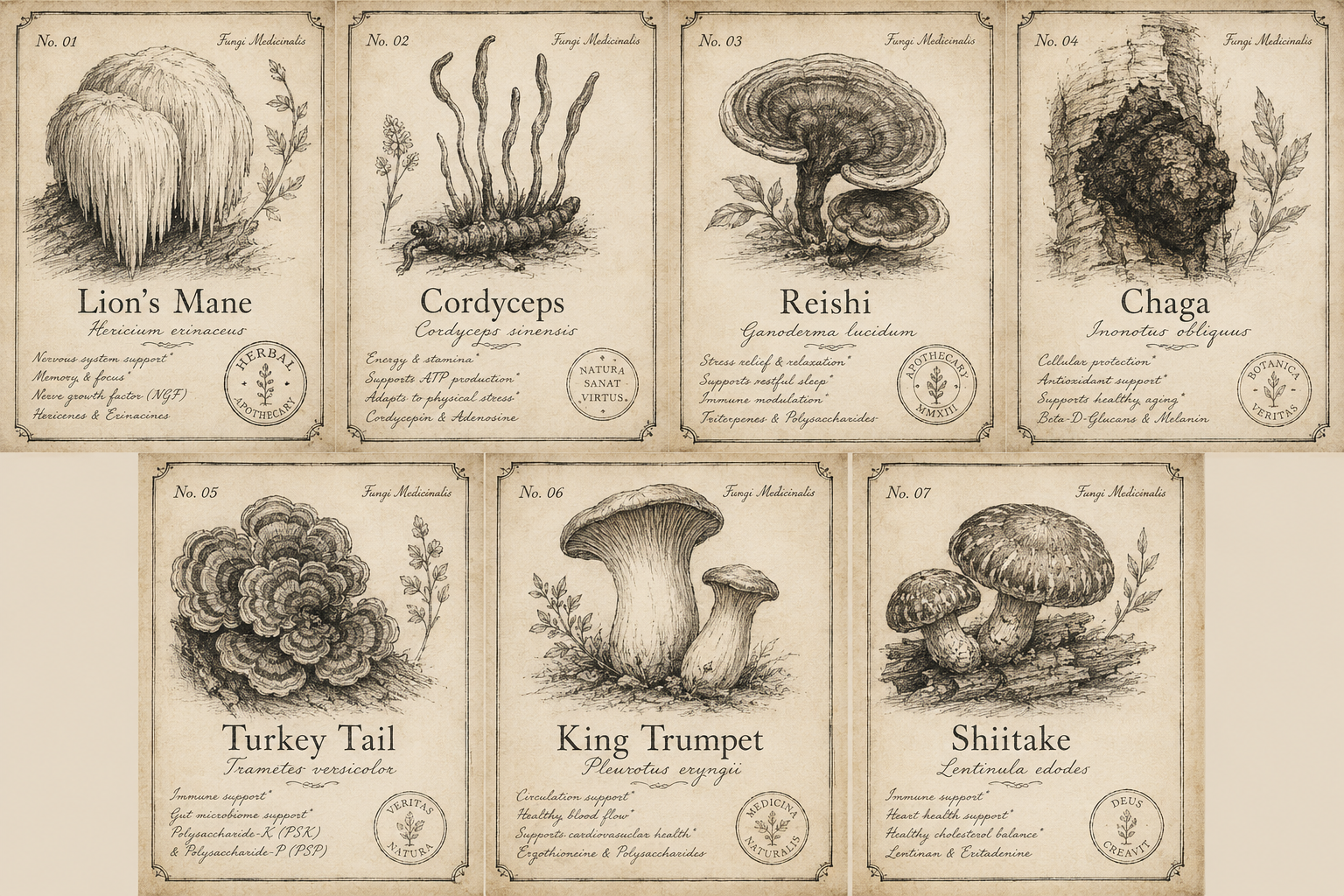
Out of the seven mushrooms listed on the label, Lion's Mane was the first one that really grabbed my attention. Maybe it was the name. I mean, let's be honest, if someone asked you to picture a medicinal mushroom, I doubt "Lion's Mane" would be your first guess. It sounds more like the title of an adventure novel than something you'd stir into your morning drink. Naturally, I had to see what it looked like.
Well...that certainly didn't clear things up.
Instead of the familiar mushroom cap I was expecting, I found this fluffy white ball covered in long, cascading strands that looked like a lion's mane—or maybe Cousin It from The Addams Family hanging from the side of a tree. I actually laughed out loud because my first thought was, Who looked at this thing and thought, "Yep...I'm going to eat that?" Apparently someone much braver than I am. Or at least a whole lot more curious.
Once I got past its unusual appearance, I discovered that Lion's Mane isn't some trendy mushroom that suddenly appeared because the wellness industry needed something new to talk about. People have been using it for centuries, particularly throughout China, Japan, and other parts of Asia, where it has a long history as both a culinary mushroom and one valued in traditional wellness practices. That alone fascinated me. Every time I discover something that's been appreciated for hundreds—or even thousands—of years, I can't help but wonder what people noticed long before modern science had the tools to explain it.
Of course, that curiosity led me straight to today's research, and that's where things became really interesting. Scientists have identified unique compounds in Lion's Mane called hericenones and erinacines. I know...those names sound like something from high school chemistry class, and I still have to slow down when I say them. What makes them so intriguing is that researchers are studying how they may support the body's natural production of something called Nerve Growth Factor, or NGF.
The first time I read "Nerve Growth Factor," my eyes almost glazed over. It sounded incredibly technical until I stopped and reminded myself that if I couldn't explain it over a cup of coffee, I probably didn't understand it yet. Here's the simplest way I can describe it. NGF is a protein that helps support the growth, maintenance, and survival of certain nerve cells. Since our brains depend on healthy communication between billions of nerve cells, it's easy to understand why researchers are so interested in anything that might support those natural processes. They're not claiming Lion's Mane is a miracle or that it can cure disease. They're simply asking some really fascinating questions, and I love that.
That part hit home for me because one of the things I've struggled with over the years has been brain fog. If you've ever walked into a room and completely forgotten why you went there, searched for your phone while it was in your hand, or felt like your thoughts were moving through molasses, you know how frustrating that can be. Between the accident, hormonal changes, stress, and years of fatigue, there were plenty of days when I didn't feel like the sharpest version of myself. So naturally, I wanted to learn everything I could about why Lion's Mane had become such an exciting area of research.
One thing I appreciated as I kept reading was how careful many of the researchers were with their conclusions. They weren't making outrageous promises or claiming to have all the answers. In fact, many of them ended with the same phrase: more research is needed. Surprisingly, that didn't disappoint me. It actually made me smile because it reminded me that science is really just organized curiosity. Every study answers one question while opening the door to ten more, and I think that's one of the things I love most about learning. We don't have to know everything today. We just have to keep asking good questions.
By the time I closed my notebook that evening, I realized Lion's Mane had given me something I wasn't expecting. Yes, I had learned about an incredible mushroom. Yes, I had a much better understanding of why researchers are excited about it. But more than anything, it reminded me how little I actually know—and oddly enough, I found that incredibly exciting. There is still so much to discover about the human body, about nature, and about the incredible ways they work together. For someone who's naturally curious, that's not frustrating at all.
It's an invitation.
And with that, I turned the page to the next mushroom on the list...wondering what other surprises were waiting for me.
Cordyceps: The Mushroom That Changed the Way I Think About Energy
If Lion's Mane was the mushroom that first pulled me down the rabbit hole, Cordyceps was the one that made me stop and say, "Wait...what?" I'll admit it—the first time I looked it up, I wasn't exactly reassured. There were headlines about "zombie fungus," stories about insects, and enough dramatic photos to make me wonder why anyone would willingly put this in a drink. Then, of course, there was The Last of Us, which certainly didn't help Cordyceps' reputation. For a few minutes I sat there thinking, People actually consume this?
Thankfully, curiosity won again.
The more I read, the more I realized the Cordyceps used in modern supplements isn't the horror-movie version the internet loves to talk about. Today's supplements are typically made from cultivated varieties grown in carefully controlled environments. Once I got past the sensational headlines, I discovered something much more interesting. Cordyceps has been used for centuries in traditional Chinese wellness practices, where it has long been valued for supporting vitality, stamina, and endurance. Considering my own history with fatigue, I knew I had to keep reading.
Living with fatigue changes the way you think about energy. People who wake up refreshed probably don't spend much time thinking about it because it's simply there. But when you've spent years feeling exhausted, energy becomes something you constantly negotiate with. You begin planning your life around it.
Even today, I still catch myself looking at my calendar differently than I used to. Before I schedule appointments, volunteer for something, or commit to a busy weekend, I mentally map out the days ahead. Which day will be the busiest? Where can I leave myself room to recharge? If I have a full day on Saturday, maybe Sunday needs to stay quiet. The difference is that years ago I planned that way because I was afraid I'd completely wear myself out. Today, I do it because I've learned to listen to my body instead of pushing past what it's trying to tell me. That's not weakness. That's wisdom earned through experience.
For years, I thought of energy as something I either had or didn't have. If I woke up exhausted, I just accepted that it was going to be one of those days. I've never been an energy drink person—they've always made me feel sick—and even too much caffeinated coffee leaves me jittery instead of energized. So I wasn't looking for another stimulant or a quick fix. I was looking for answers. Looking back, I realize I spent a lot of years trying to work around my body's exhaustion instead of understanding why it was there in the first place.
That's one of the reasons Cordyceps fascinated me so much.
As I continued reading, I came across something that made me smile because it felt strangely familiar. ATP.
If you've been reading along with me over the past few weeks, you might remember our deep dive into creatine. We spent quite a bit of time talking about ATP, often called the body's energy currency. Every heartbeat, every breath, every step you take, every thought you think depends on ATP. It's the molecule our cells use to power nearly everything they do.
Apparently, ATP had decided to follow me down another rabbit hole.
Cordyceps and creatine aren't doing the same job, but both led me back to the same fascinating realization. Researchers have been studying Cordyceps because of its potential role in supporting the body's natural production of ATP and how efficiently our bodies utilize oxygen, particularly during physical activity. The research is still evolving, but I found it fascinating that two completely different topics kept leading me back to the same place.
Energy isn't just a feeling.
It's a process.
For years, I thought of energy as something I either had or didn't have. If I was tired, I'd pour another cup of coffee. If I was still tired, I'd push a little harder. Rest felt like something I had to earn instead of something my body genuinely needed. Looking back, I realize I spent a lot of years trying to override what my body was trying to tell me.
Don't get me wrong—I still love my coffee. Anyone who's read my blog for very long already knows that. But coffee gives me a temporary lift. Learning about ATP and the incredible way our cells produce energy gave me something much more valuable: a deeper appreciation for what my body is already doing every single second of every single day.
As I closed my notebook that evening, I realized Cordyceps hadn't simply taught me about another mushroom. It had changed the questions I was asking.
Instead of wondering why my body couldn't keep up with everything I expected of it, I started wondering what it needed from me.
That may sound like a small shift, but for me, it changed everything.
Because once you stop fighting your body and start supporting it, you begin to see it differently. Not as something that's broken or working against you, but as an incredibly intelligent system that's been doing its very best to protect you all along.
And somehow, that realization gave me more hope than any energy drink ever could.
Reishi: The Mushroom That Taught Me to Appreciate Rest
By the time I got to Reishi, I was beginning to notice a pattern.
Every mushroom seemed to challenge something I thought I already understood.
Lion's Mane made me rethink my brain.
Cordyceps made me rethink energy.
Reishi made me rethink something even more personal.
Rest.
I'll admit, I used to think rest was something you earned. Finish the project. Cross everything off the to-do list. Answer one more email. Fold one more load of laundry. Maybe reorganize the pantry while you're at it. Then—and only then—you could finally sit down without feeling guilty.
The problem, of course, is that the to-do list has a funny way of reproducing overnight. I swear I can cross off five things before lunch and somehow there are seven new ones by dinner. If someone could explain that math, I'd appreciate it.
For years, I treated rest like a reward instead of something my body genuinely needed. If I was tired, I assumed I just needed to push a little harder. If I couldn't keep up, I blamed myself instead of asking what my body was trying to tell me. Looking back, I realize I spent far too much time trying to convince my body to keep going instead of thanking it for carrying me as far as it already had.
Then I met Reishi.
Reishi has been treasured in traditional Chinese wellness practices for more than two thousand years and has earned the nickname "The Mushroom of Immortality." That's quite a title. The skeptic in me couldn't help but laugh a little. Immortality? Really? I wasn't looking to live forever. I was just hoping to make it through the afternoon without feeling completely wiped out.
But once I looked past the dramatic nickname, I found myself fascinated again. Reishi isn't known for giving you a burst of energy like another cup of coffee or making you feel like you could suddenly run a marathon. Instead, it's been traditionally valued for supporting relaxation, helping the body adapt to stress, and encouraging overall balance.
There was that word again.
Balance.
It seemed like every rabbit hole I wandered down eventually circled back to the same idea. Our bodies are constantly working to keep everything in balance, even when we make that job incredibly difficult.
The more I read about stress, the more I realized it isn't just something we feel. It's something our bodies experience on a very real, physical level. When we're faced with danger, our bodies release hormones like cortisol to help us react quickly. It's an amazing system, really. If a bear suddenly wandered into your backyard, you'd probably appreciate every bit of that built-in survival response.
The problem is...most of us aren't running from bears.
We're running from overflowing inboxes.
Doctor appointments.
Family responsibilities.
Deadlines.
The never-ending ding of another notification.
Traffic.
Bills.
Laundry that somehow multiplies when no one's looking.
Our bodies don't always know the difference.
That same beautifully designed stress response that was meant to help us escape danger can end up running almost nonstop in modern life. No bears required.
As I read more about Reishi, I couldn't help but smile because once again I wasn't discovering that my body was broken. I was discovering that it was doing exactly what it had been designed to do. It wasn't trying to make my life difficult. It was trying to protect me.
That realization changed something for me.
Instead of asking, "Why can't I keep up?" I started asking, "How can I help my body feel safe enough to slow down?"
Those are two very different questions.
I still have busy days. I still have deadlines. I still catch myself trying to squeeze one more thing into an already full schedule. Old habits don't disappear overnight. But now, when I intentionally leave space on my calendar or choose to spend a quiet evening at home instead of pushing through one more commitment, I don't see it as giving up.
I see it as working with my body instead of against it.
And somehow, that's one of the biggest lessons this little mushroom had to teach me.
Chaga: The Mushroom That Made Me Appreciate Repair
By the time I got to Chaga, I was beginning to notice another pattern.
Every mushroom seemed to pull back another layer of just how incredibly designed the human body really is. First, I found myself marveling at the brain with Lion's Mane. Then Cordyceps sent me down the fascinating rabbit hole of cellular energy and ATP. Reishi completely changed the way I thought about stress and rest. Just when I thought I had wrapped my mind around all of that, Chaga introduced me to something I had honestly never given much thought to before.
Oxidative stress.
Even writing those words makes me smile because if someone had asked me six months ago what oxidative stress actually meant, I probably would have smiled politely, nodded as though I knew exactly what they were talking about, and quietly changed the subject. I'd heard the term countless times. I knew antioxidants were supposed to be good for me because every commercial, magazine article, and wellness website seemed to mention them. Blueberries had antioxidants. Green tea had antioxidants. Dark chocolate supposedly had antioxidants, which was probably my favorite discovery up to that point. But if you'd asked me to explain what antioxidants actually did, I couldn't have.
So, naturally, I started reading.
Somewhere along the way, I finally looked up a picture of Chaga itself, and I'll admit, I laughed out loud. Of all the mushrooms I'd researched so far, this one looked the least inviting. It didn't resemble the mushrooms I'd tossed into stir-fries or ordered on pizza. It looked like someone had broken a chunk of charcoal off a campfire and stuck it to the side of a birch tree. If I'd stumbled across it during a walk in the woods, I certainly wouldn't have thought, Well, that looks healthy.
Apparently, Mother Nature isn't nearly as concerned with appearances as the rest of us.
The more I read, the more I learned that people living in Russia, Northern Europe, and parts of Asia had been brewing Chaga into teas for centuries, long before anyone could explain oxidative stress or identify antioxidants under a microscope. Once again, I found myself appreciating the wisdom of generations who observed nature long before modern science had the vocabulary to describe what they were seeing. Research continues today, but I love that science is often catching up to what traditional practices recognized long ago.
It wasn't until I came across an analogy about rust that everything finally clicked.
Think about an old bicycle that's been left outside for years, or maybe an old pickup truck that's survived more winters than anyone can count. Rust doesn't suddenly appear one Tuesday afternoon and take over the whole vehicle. It happens gradually. A tiny spot here. A little discoloration there. Year after year, the effects of weather and oxygen slowly wear away at the metal until one day you notice that it isn't quite what it used to be.
Our bodies experience something surprisingly similar.
Simply being alive creates what scientists call oxidative stress. Every breath we take, every meal we digest, every ray of sunshine, every time our cells produce energy, tiny unstable molecules called free radicals are created. That's not a sign that something is wrong. It's simply part of being alive. In fact, it's impossible to avoid because it's part of how our bodies function.
What fascinated me was learning that our bodies aren't passively sitting back while all of this happens. They're constantly responding. They produce their own antioxidants, and we get additional antioxidants through many of the foods we eat. Together, they're part of an incredibly sophisticated system that helps neutralize excess free radicals before they can cause more damage. It's less like repairing a catastrophic breakdown and more like performing faithful, everyday maintenance.
Suddenly, antioxidants weren't just another wellness buzzword.
They made sense.
They weren't magic. They weren't a miracle cure. They were one more example of the body doing what it was beautifully designed to do—protect itself, repair itself, and constantly work toward balance.
I think that's what stayed with me long after I closed my laptop that evening.
For years, I had measured my health by the things I could see. Did I have enough energy? Was I in pain? Could I keep up with everything on my calendar? But beneath the surface, my body had been performing millions of tiny acts of protection every single day without asking for recognition. It wasn't waiting for applause every time it repaired a damaged cell or helped defend against the normal wear and tear of life. It simply kept showing up, faithfully doing the work it was created to do.
That's becoming the theme of this entire rabbit hole.
Every mushroom has taught me something different, but they all seem to lead me back to the same realization. My body isn't fragile. It isn't working against me. It's remarkably resilient, incredibly intelligent, and constantly trying to protect me—even on the days when I never stopped to notice.
Turkey Tail: The Mushroom That Made Me Appreciate My Immune System
By the time I reached Turkey Tail, I had stopped pretending that this was still a simple little research project. Every mushroom seemed to open a door into some part of the human body I had spent most of my life barely thinking about, and once I walked through that door, there was no such thing as a quick glance around. Lion’s Mane had led me into the brain. Cordyceps had made me think differently about energy. Reishi had challenged the way I thought about rest, and Chaga had introduced me to the quiet work of repair that is happening inside the body all the time. Turkey Tail, as it turned out, was going to lead me toward the immune system, which was especially interesting because the immune system was one of those things I had always appreciated only in theory. I knew it was important, of course, but unless I was sick, fighting off a cold, or waiting for some kind of test result, I rarely gave it much thought. It worked in the background, and as long as it stayed in the background, I was perfectly content to let it remain there.
The mushroom itself was a welcome change after Chaga. Chaga had looked like a scorched chunk of wood that someone might scrape off a tree and toss into a fire, but Turkey Tail actually looked like something that belonged in a nature book. It grows in thin, layered fans along fallen logs and tree trunks, with rings of brown, cream, gray, and sometimes faint blue running through it in patterns that really do resemble the feathers of a turkey. For once, the person responsible for naming a mushroom had made a choice I could understand immediately. It was delicate and almost decorative, which felt slightly misleading considering how much scientific attention it had received. I was beginning to learn that mushrooms have a habit of looking either completely unremarkable or mildly suspicious while quietly containing enough complexity to keep researchers occupied for decades.
As I read, I learned that Turkey Tail has a long history of use in traditional medicine, particularly in Asia, and that this history eventually caught the attention of scientists who wanted to understand what, exactly, people had been using all those years. Researchers identified compounds known as polysaccharide-K, or PSK, and polysaccharopeptide, or PSP, names I was grateful had been shortened because I could barely make it through the full versions without losing my place. These compounds became especially interesting because of the way they appeared to interact with the immune system. What caught my attention was that the conversation was not really about “boosting” immunity in the simple, cheerful way the word is often used on product labels. The immune system is not a light switch that needs to be flipped into a permanently higher setting. It is a complicated network that has to recognize threats, communicate accurately, respond appropriately, and then know when to settle back down. Too little activity can leave the body vulnerable, while too much or poorly directed activity can create an entirely different set of problems. The idea that certain compounds might help influence or support that system was much more nuanced than the usual wellness language, and naturally, that nuance sent me deeper into the research.
Then I came across something that made me stop reading for a while. In Japan, PSK has been used for decades alongside conventional treatment in certain cancer settings. Not instead of chemotherapy, surgery, radiation, or other standard care, and certainly not as some hidden cure that doctors elsewhere had somehow missed, but as an adjunct used as part of a larger treatment plan. That distinction mattered to me. I was not interested in dramatic promises or in turning a mushroom into a miracle. What fascinated me was the fact that something derived from Turkey Tail had been studied seriously enough to become part of medical practice in another country. It was an example of traditional use leading to scientific questions, scientific questions leading to research, and research gradually shaping clinical decisions. There was still uncertainty, and there was still much more to learn, but I found the entire process compelling because it showed how medicine often moves forward—not through one grand discovery, but through years of careful questions, cautious conclusions, and people willing to keep looking.
As I sat there reading, my thoughts drifted to my dad and to the years when cancer became part of our family’s language. During his cancer journey, we did what families do when they are frightened and trying to make good decisions in a situation none of them ever wanted to face. We listened to his doctors, followed the treatment plan, prayed, hoped, and tried to make sense of information that never seems to arrive slowly enough for you to absorb it. We made the best decisions we could with the knowledge we had at the time, and I believe that deeply. Still, learning about Turkey Tail all these years later stirred up a thought I had not expected. I found myself wondering whether it might have been something worth discussing with his oncology team. I do not know what they would have said. The answer may have been no. It may not have been appropriate for his specific cancer, his treatment, his health, or the circumstances he was facing. It may not have changed a single thing. There is no way to know, and I have no desire to rewrite the past with information I did not have then. But I do wish we had known enough to ask the question, because sometimes the ache is not that you believe you missed a cure. Sometimes it is simply that you wish you had known there was one more conversation you might have had.
That thought stayed with me longer than the scientific terminology did. One of the difficult things about learning is that new information does not always remain neatly in the present. Sometimes it reaches backward and touches experiences you have already lived, and for a moment you find yourself holding the knowledge you have now beside the choices you made then. That can be painful, even when you know you did nothing wrong. We cannot go back and make decisions with information that was not available to us, and we cannot fairly judge earlier versions of ourselves for not knowing what we know today. What we can do is keep learning, keep asking thoughtful questions, and remain open to the possibility that science will continue uncovering options for people who come after us. That does not erase grief, and it does not turn uncertainty into certainty, but it does leave room for hope. It made me hopeful that future families may walk into treatment rooms with better information, broader conversations, and more possibilities than the families who came before them.
After I sat with those thoughts, I found myself returning to the immune system itself, and I realized how little credit I had given it over the years. I had always thought of immunity as something that appeared during an emergency. A virus entered the body, the alarm sounded, and the immune system rushed in like a team of firefighters. The more I read, the more I understood that this image was far too simple. The immune system is not sitting in a station waiting for smoke. It is constantly working, identifying what belongs and what does not, remembering earlier infections, communicating between cells, responding to damaged tissue, and making microscopic decisions I will never be aware of. It has been performing this work every day of my life without asking me to understand the process, and perhaps the reason I rarely noticed it was because so much of that work had been successful.
Most of us notice our bodies when something interrupts us. We notice the fever, the cough, the fatigue, the pain, and the diagnosis because those things force themselves into the center of our lives. What we do not notice are the ordinary mornings when we wake up feeling fine, the errands we run, the meals we make, and the days that unfold without illness ever becoming part of the story. I had never considered that some of those uneventful days might be uneventful precisely because my body had already handled something before I became aware of it. I did not congratulate my immune system for recognizing a threat, organizing a response, or clearing away a damaged cell. I did not pause to appreciate the millions of communications taking place inside me while I was answering emails or deciding what to make for dinner. The absence of a crisis had always felt like nothing was happening, when in reality it may have meant that an extraordinary amount of work had been done so quietly and efficiently that I never had to know about it.
That realization fit into the larger pattern the mushrooms had been revealing to me. I had spent years measuring my body by the moments when it seemed to disappoint me: the brain fog, the exhaustion, the stress, the days when I could not keep up with my own expectations. Those moments were easy to remember because they interrupted my plans and demanded my attention. What was easier to overlook was everything my body continued doing well. My brain kept adapting and processing the world around me. My cells kept producing energy. My stress response kept trying to protect me, even when modern life asked it to stay switched on longer than it was designed to. My body kept repairing the ordinary damage that comes with being alive, and my immune system kept standing guard in ways I would never see. None of those systems were perfect, and neither was I, but the more I learned, the harder it became to think of my body as an obstacle I had to fight or control.
By the time I finished reading about Turkey Tail, I understood that the real rabbit hole was no longer about mushrooms at all. The mushrooms had simply become the doorway into a different way of seeing the body God created. Each one had drawn my attention toward something I had taken for granted, and Turkey Tail had reminded me that protection does not always look dramatic. Sometimes it looks like an illness that never arrives, a damaged cell that is handled quietly, or an ordinary day that passes without incident because the body has already been faithfully doing its work. The mushrooms were not changing my body nearly as much as they were changing the way I looked at it, and I was beginning to think that may have been the most important thing I discovered.
King Trumpet: Learning to Appreciate the Heart
By the time I reached King Trumpet, I noticed something had changed—not about the mushrooms themselves, but about the way I was reading about them. At the beginning of this rabbit hole, I was mostly looking for benefits. I wanted to know what each mushroom supposedly did, whether the claims were backed by research, and whether they were worth paying attention to. Somewhere along the way, though, my questions shifted. I stopped asking only, What does this mushroom do? and started asking, What does this teach me about the incredible way God designed the human body?
That turned out to be a much better question.
King Trumpet isn't nearly as well known as Lion's Mane or Reishi. You don't hear people talking about it very often, and before this journey, I probably would have walked right past it in the store without giving it a second thought. It seemed to be one of those quiet, unassuming mushrooms that simply goes about its business without demanding attention.
The more I learned, the more fitting that seemed.
As I dug into the research, I came across a compound I'd never even heard of before: ergothioneine. The name alone made me stop, but what fascinated me even more was learning that our bodies actually have a specific transporter dedicated to carrying this naturally occurring antioxidant into tissues that experience higher levels of oxidative stress. Researchers are continuing to study exactly how it functions, but its relationship to cellular protection and cardiovascular health has made it an exciting area of research.
I smiled because, once again, this rabbit hole had introduced me to something I had gone my entire life without knowing existed.
Of course, one discovery led to another. Before long I found myself reading about blood vessels, circulation, inflammation, cholesterol, arteries, and the incredible complexity of the cardiovascular system. I realized I'd spent years hearing people say, "Take care of your heart," without ever stopping to think about what an astonishing organ it really is.
Then life made the lesson personal.
Just a couple of weeks ago, I found myself sitting beside my mom in the emergency room after an abnormal EKG sent us down a road neither of us expected. Thankfully, the testing in the ER ruled out the immediate emergencies we feared. The doctors did find some plaque buildup, which explained why more questions still needed answers, but it wasn't the devastating diagnosis we had imagined on the drive to the hospital.
We're still in the middle of that story.
She has more testing scheduled this week, and like so many families navigating health concerns, we're waiting. Waiting for more information. Waiting to see what the next test reveals. Waiting while trying not to let our minds race ahead of what we actually know.
Waiting has a way of changing your perspective.
When someone you love is connected to heart monitors and people begin talking about rhythms, arteries, circulation, and blood flow, those words stop sounding like medical terminology from a textbook. They become deeply personal. You listen more carefully. You ask more questions. You pray more intentionally. You become grateful for every piece of information that helps you better understand what's happening, while remembering that ultimately our lives have always been in God's hands.
Reading about King Trumpet during this season didn't make me think I'd discovered some miracle hidden inside a mushroom. Instead, it reminded me how unbelievably intricate the human heart really is. The more I learned about the cardiovascular system, the more I realized how much there still is to learn. Research continues. Medicine continues to evolve. We do the best we can with the knowledge we have today while continuing to seek wisdom, and ask questions.
Sometimes stewardship looks like eating well and staying active. Sometimes it looks like sitting in a waiting room while doctors gather the information they need.
As I watched my mom walk through appointments and additional testing, I found myself thinking less about what might be wrong with her heart and more about everything it has faithfully done right for so many years.
That heart carried her through pregnancy.
It beat through sleepless nights raising children.
It carried her through family dinners, anniversaries, celebrations, family vacations, ordinary mornings drinking coffee, difficult seasons that only God knew about, and countless moments of laughter that became some of my favorite memories.
For decades it has simply shown up.
Quietly.
Faithfully.
Without asking for applause.
I think that's what this entire mushroom rabbit hole has been teaching me.
We spend so much of our lives noticing our bodies only when something goes wrong. We notice the ache, the diagnosis, the wrinkle, the fatigue, the extra pounds, or the limitation. Those things naturally command our attention because they interrupt our lives.
But what if we noticed everything that's quietly going right?
The average heart beats around one hundred thousand times every single day.
It never asks whether today is convenient.
It doesn't take weekends off.
It doesn't complain when life becomes stressful.
It simply keeps beating.
Day after day.
Year after year.
Long before I ever became curious about mushrooms, my heart—and my mom's heart—had already been faithfully doing exactly what God designed them to do.
King Trumpet didn't leave me thinking primarily about antioxidants or cholesterol.
It left me thinking about faithfulness.
The quiet kind.
The kind that rarely gets noticed because it's so dependable we almost forget it's there.
As I continue praying for my mom and waiting with her for more answers, I've found myself appreciating my own heart a little more as well. Not because it's perfect, and not because any of us are guaranteed tomorrow, but because it has faithfully carried me through every ordinary day, every celebration, every heartbreak, every answered prayer, and every unexpected detour of my life.
I started this journey thinking I was researching mushrooms.
Instead, I found myself overwhelmed with gratitude for the extraordinary body God created.
And every mushroom seems to keep reminding me of the same beautiful truth: the more I learn about His creation, the more I stand in awe of the Creator Himself.
Shiitake: More Than the Sum of Its Parts
By the time I reached Shiitake, I found myself smiling because, unlike some of the other mushrooms I'd been reading about, this one wasn't exactly a stranger. Shiitake has been part of traditional diets throughout Asia for centuries, and unlike King Trumpet or Chaga, it's one that many of us recognize from the grocery store or the menu at our favorite Asian restaurant. It's probably the most familiar mushroom in this entire collection, yet, like so many familiar things, I realized I had never stopped to wonder what made it unique.
Ironically, after spending all this time researching mushrooms, I still have to confess something: I don't actually enjoy eating them. I've tried. I really have. I wish I liked them as much as everyone else seems to, but no amount of butter, garlic, or seasoning has managed to convince my taste buds that mushrooms belong on my dinner plate. That's one of the reasons I was so surprised when I tried Rise. Somehow they've managed to blend seven mushrooms into a drink that doesn't taste like mushrooms at all. In fact, it's become one of those things I genuinely look forward to each morning. I never imagined I'd say I crave something made with mushrooms, but here we are.
That little realization made me laugh because somewhere along the way I had become fascinated by mushrooms without ever becoming a mushroom enthusiast. My interest wasn't really in the mushrooms anymore. It was in what they were teaching me.
As I began reading about Shiitake, I found many of the same themes that had surfaced throughout this journey. Researchers have identified compounds such as lentinan, a beta-glucan that has been studied for decades because of its role in supporting normal immune function, along with eritadenine, a naturally occurring compound that has drawn scientific interest for the way it may influence cholesterol metabolism. Shiitake is also naturally rich in B vitamins, minerals like copper and selenium, fiber, and antioxidants that help protect our cells from oxidative stress. The more I read, the more I realized that Shiitake isn't remarkable because of one extraordinary compound. It's remarkable because of the way so many naturally occurring compounds exist together, each contributing something different.
That thought stayed with me long after I closed the research papers.
Throughout this rabbit hole, I had been looking at one mushroom at a time. Lion's Mane made me appreciate the incredible complexity of the brain. Cordyceps reminded me how miraculous it is that our bodies are able to produce energy at all. Reishi helped me see rest as one of God's gifts instead of something to feel guilty about. Chaga taught me to appreciate the body's remarkable ability to repair itself. Turkey Tail left me in awe of an immune system that quietly protects us every day, and King Trumpet reminded me not to take the faithful work of the heart for granted.
But Shiitake quietly tied all of those lessons together.
The more I learned, the more I realized the body doesn't divide itself into neat little categories the way we often do. The brain depends on oxygen delivered by the heart. The heart depends on nourishment carried through the bloodstream. The immune system depends on healthy cells. Rest affects healing. Stress influences nearly everything. Every organ, every system, every microscopic process is connected to something else in ways we're still discovering. Nothing inside us works in complete isolation.
Looking back now, I smile at how innocent this whole journey began. I thought I was chasing answers about seven mushrooms. Instead, I found myself wandering into conversations about neuroscience, cellular repair, energy production, sleep, immune function, antioxidants, circulation, and the astonishing complexity of the human body. Every rabbit hole opened into another one, and each discovery reminded me how little I actually knew. That's the funny thing about curiosity. If you follow it long enough, it has a way of leading you somewhere completely different from where you expected to go.
I suppose that's what surprised me most about this entire experience. I began researching seven mushrooms because I wanted to know whether they deserved all the attention they were getting. Instead, I walked away captivated by something far more extraordinary. Every scientific paper seemed to reveal another layer of complexity inside the body God created, and every answer uncovered another question I hadn't even thought to ask. Rather than convincing me that we've figured everything out, the research left me humbled by how much there still is to learn.
The deeper I wandered into the science, the greater my sense of wonder became. We can describe biochemical pathways, identify antioxidants, isolate naturally occurring compounds, and map out physiological processes with incredible detail, but none of that diminishes the miracle. If anything, it magnifies it. Every new discovery feels less like an explanation and more like another glimpse into the breathtaking wisdom of the Creator.
When I first opened my laptop to learn more about these seven mushrooms, I honestly thought I was researching a supplement.
I never imagined I would end up with a deeper appreciation for my own brain, my heart, my immune system, or the countless unseen processes faithfully sustaining my life every single second of every single day. I never imagined that learning about mushrooms would change the way I looked at the body I'd been living in my entire life. And I certainly never imagined I'd finish this journey still refusing to eat mushrooms while genuinely looking forward to drinking them every morning.
In the end, the mushrooms were never really the point.
They were simply the invitation.
The invitation to slow down.
To ask better questions.
To pay attention to the extraordinary things happening inside me every moment that I never stop to notice.
To trade criticism for gratitude.
To replace familiarity with wonder.
The more I learned about these seven mushrooms, the more I found myself marveling at something infinitely greater than mushrooms themselves. I found myself overwhelmed with gratitude for the extraordinary body God designed. It isn't perfect. None of ours are. They bear the effects of living in a fallen world, and they require care, wisdom, and sometimes difficult seasons of waiting. But even in their imperfections, they remain astonishing.
Maybe that's where this rabbit hole was always leading.
Not to mushrooms.
Not even to science.
But to worship.
Because the closer I looked at His creation, the more I found myself whispering the words of David with a deeper understanding than ever before:
"I praise you because in an awe-inspiring way I am wonderfully made. Your works are wonderful, I know this very well." — Psalm 139:14