I Thought Everyone Grew Up Like This
I Thought Everyone Grew Up Like This
For the longest time, I thought everybody grew up the way I did.
It wasn't until I became an adult and started comparing notes with other people that I realized my version of normal might have been a little different. I thought everybody had grandparents who made sauerkraut and horseradish from scratch. I thought everybody spent part of their summer canning vegetables and preserving food for winter. I thought everybody's dad was forever chasing a new health idea, and everybody's mom could somehow manage a household, a garden, a farm, and a sewing room without ever seeming to stop moving.
As it turns out, that wasn't everyone's normal.
I grew up in a farming community where life followed the rhythm of the seasons. Spring meant planting. Summer meant tending gardens, pulling weeds, and trying to stay ahead of whatever needed doing next. Fall meant harvest. Winter meant preparing to do it all over again. We raised animals for meat, grew much of our own food, and spent countless hours preserving whatever the garden produced. Looking back now, I realize how much work that actually was. At the time, it just felt like life.
Some of my favorite memories happened in the garden. I was completely obsessed with yellow pear tomatoes, and if you've never eaten one warm from the vine, you're missing out on one of life's simple pleasures. They were sweet, tiny, and somehow tasted like sunshine. My mom would send me out with a bowl and instructions to pick tomatoes for dinner, usually reminding me not to eat them all before I got back to the house. The fact that she continued trusting me with this responsibility year after year still amazes me because I was spectacularly bad at it.
I always intended to bring home a full bowl. That was genuinely the plan. Then I'd get to the garden, spot a perfectly ripe tomato, and decide one wouldn't hurt. Then another. Then maybe one more. Before long, I was standing in the middle of the garden eating tomatoes directly off the vine while holding a bowl that was supposed to be getting fuller. By the time I got back to the kitchen, there were usually fewer tomatoes than there should have been. Mom would glance at the bowl, glance at me, and somehow know exactly what had happened without asking a single question.
The kitchen was the heart of everything in our family. It was where meals were made, conversations happened, and projects unfolded. It was also where my father's latest health discoveries eventually landed. My dad was one of the most curious people I've ever known. He was constantly reading, researching, learning, and looking for ways to improve things. If there was a book about nutrition, he wanted to read it. If there was a new idea about health, he wanted to understand it. If there was a question nobody else was asking, there was a good chance Dad was already halfway down the rabbit hole.
Looking back, I realize our family's approach to health wasn't exactly mainstream. When someone got sick, our first thought wasn't always to run to the doctor. More often than not, the conversation started with, "What else can we try?" That usually led to herbs, home remedies, nutrition, or some piece of wisdom someone had picked up along the way. Some of those remedies made perfect sense. Others were a little more memorable.
For example, if I get congested today, one of the first things I still think about is garlic tea. Actually, that's not entirely accurate. A garlic tea enema. There. I said it. 🤓 I can practically hear some of you backing away from your screens right now. The funny thing is that growing up, it never occurred to me that this might be unusual. It was simply one of the remedies in our family's toolbox, right alongside chicken soup and herbal teas. Years later, I still use it when I'm congested because, for me, it works like a charm. Normal is a funny thing. You don't realize your version of normal is different until one day you casually mention a garlic tea enema and discover you've been living a very different life than most people around you.
The same could probably be said for the Shaklee vitamins. Every morning my mom would line us up in the kitchen and hand us little cups of what I can only describe as liquified alfalfa. Maybe that's not what it was. I honestly have no idea what was in that stuff. Grass clippings, maybe??? What I do know is that I can still taste it all these years later. Have you ever accidentally gotten a mouthful of alfalfa while walking through a field? No? Well, imagine that concentrated into a tiny paper cup. Mom was absolutely convinced it was making us healthier. The rest of us approached it with the enthusiasm usually reserved for dental work. Looking back, she was probably right. I still don't want another sip.
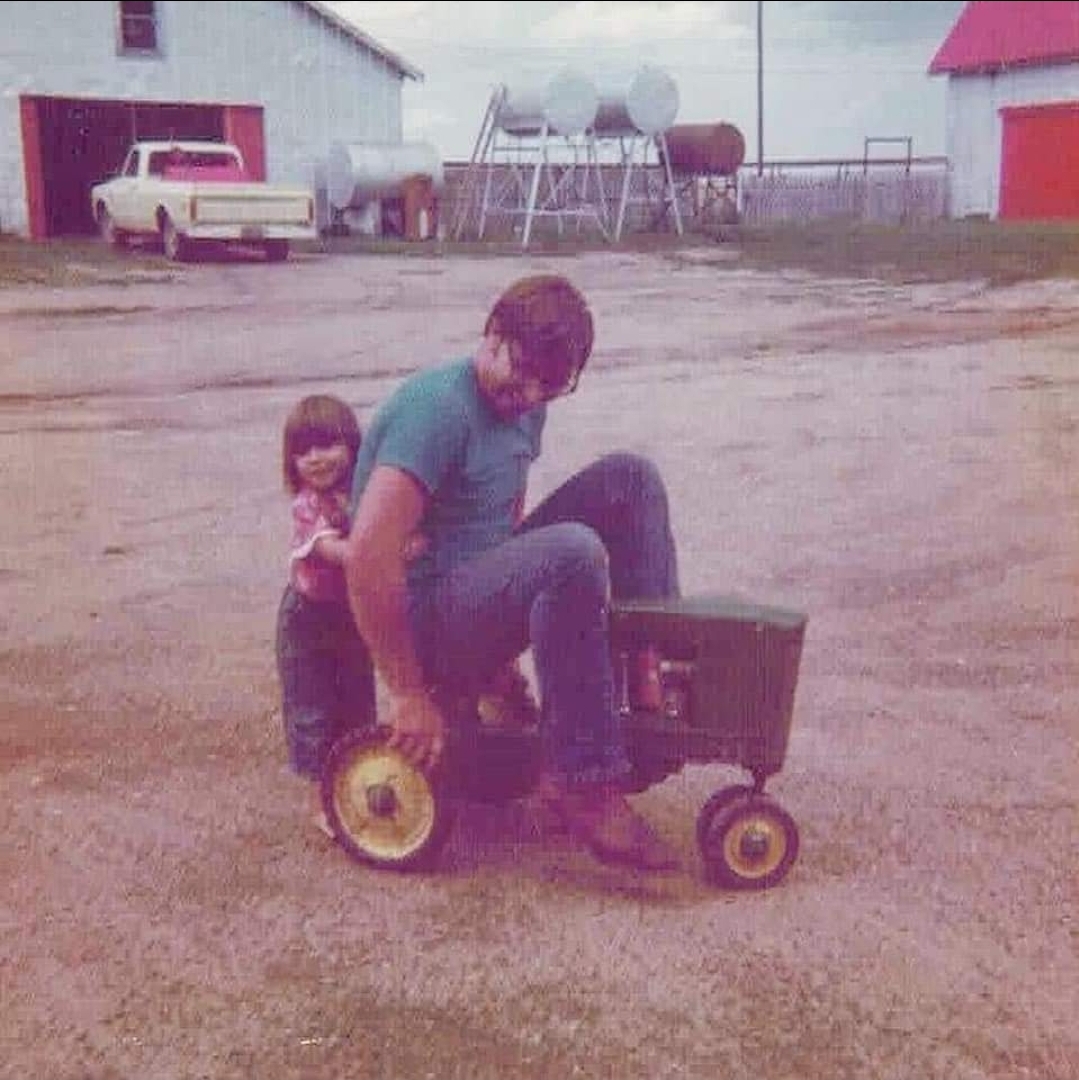
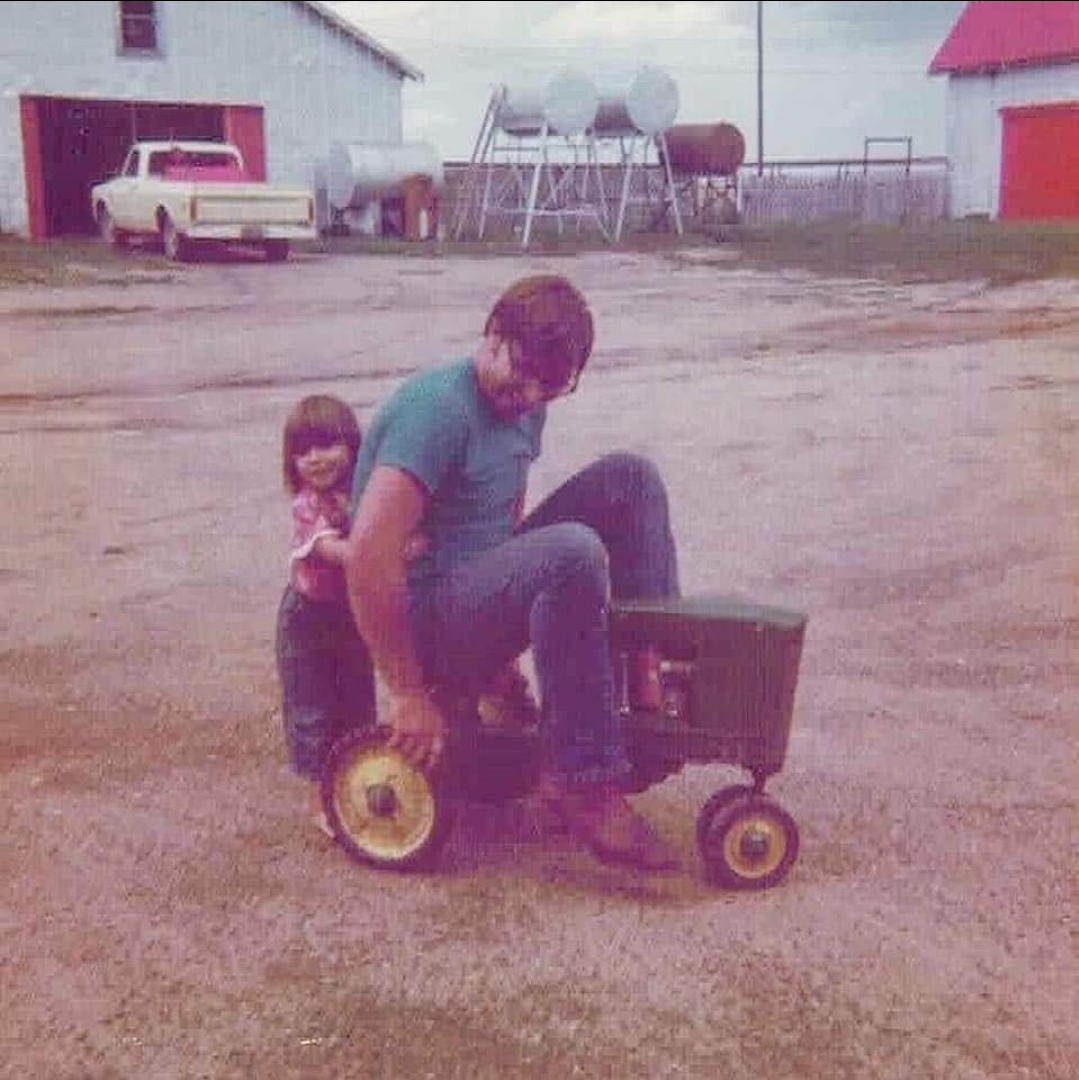
My dad's curiosity wasn't limited to health. He approached almost everything in life the same way. One of my favorite examples happened when he was bidding on a project hanging billiard cloth in a department store display. The only problem was that he had never actually hung billiard cloth before. Most people would probably consider that an important detail before saying yes to the job. My dad had a different system. He said yes first and figured it out later.
A few days later, we found ourselves making one of our regular trips into town. The same town where we'd visit the health food store also had a fabric store, so Dad bought billiard cloth, brought it home, and turned part of the barn into a practice workshop. He experimented with different adhesives, different techniques, and different approaches until he figured out what worked. By the time the project started, he knew exactly what he was doing. That was Dad. If there was a question, he wanted the answer. If there was a problem, he wanted the solution. If there was a skill he didn't have, he assumed he could learn it.
Eventually, that same curiosity led him into nutrition and diets. At one point he discovered the Pritikin diet, which, looking back, probably created significantly more work for my mother than anyone else involved. Dad got a new health adventure. Mom got homework. Suddenly recipes had to be adapted, ingredients had to be hunted down, and nearly everything had to be made from scratch. Because we lived in the middle of nowhere, finding those ingredients often meant driving thirty-five miles to a specialty store. Dad was excited. Mom was determined. The rest of us were mostly trying to figure out what had happened to dinner.
The thing about my mother is that she always found a way.
No matter what project was happening, what season we were in, or what new rabbit hole Dad had discovered, she somehow made it work. She was raising kids, helping on the farm, cooking meals, preserving food, and sewing clothes, often all at the same time. Every summer before our convention, she would make new outfits for us. Not buy them. Make them. I remember waking up in the middle of the night and seeing lights still on downstairs. There she'd be at the sewing machine, still working long after everyone else had gone to bed. Sometimes it was two in the morning. Sometimes three.
What's funny is that I've become exactly the same way.
If I'm working on a sewing project, time disappears. The brain doesn't seem to get tired. You tell yourself you're going to finish one more seam, then suddenly you look at the clock and realize it's well after midnight. The world is quiet. You should be asleep. And you're having the exact same experience your mother was having forty years earlier.
My grandparents fit perfectly into this wonderfully eccentric world. Every year Grandma made sauerkraut and horseradish. The sauerkraut had a smell all its own, but the horseradish was something else entirely. The moment that grinder started running, the entire farmhouse knew about it. Eyes watered. Noses ran. People suddenly remembered urgent tasks outside. Meanwhile, Grandma stood there calmly carrying on as if everyone else was being unnecessarily dramatic. To this day, I don't know if she'd built up an immunity or simply enjoyed watching the rest of us suffer.
One of my favorite memories happened during canning season. We were processing pears in the basement, and I was losing a battle with gravity. Pear juice seemed determined to run down my hands, down my wrists, and all the way to my elbows. Since I've never tolerated sticky hands or anything dripping particularly well, I came up with what I thought was an elegant solution. I wrapped tea towels around my wrists and forearms to catch the drips. In my mind, it was genius. In Grandma's mind, it was apparently ridiculous.
I can still see the look she gave me.
It was the look grandparents reserve for moments when they've accepted that their grandchild is perfectly functional but undeniably strange.
While all of this was happening, Hank Williams Sr. was playing on my CD player. Every now and then I'd glance over and catch Grandpa singing along while he peeled pears. He wasn't performing. He wasn't trying to entertain anyone. He was simply enjoying the music while doing the work that needed to be done. At the time it felt completely ordinary. Now it's one of those memories I'd give almost anything to step back into for a few minutes.
The older I get, the more I realize that the most important things my family taught me were never taught through lectures. They were taught through example. Dad taught curiosity without ever calling it curiosity. Mom taught resourcefulness without ever talking about resourcefulness. My grandparents taught tradition, hard work, and joy simply by the way they lived.
They also taught me that life wasn't meant to be all work.
No matter how hard we worked, we played even harder. There were weekends at the lake, camping trips with friends, long summer days spent swimming, and road trips after wheat harvest with the camper in tow. Some years we headed west into the Rockies. Other years we wandered through the Ozarks. In the winter, Dad found creative ways to take us skiing by trading his skills for a place to stay. We didn't have much by some people's standards, but it never felt that way to me. There was always another adventure waiting, another memory being made, another story we'd laugh about years later.
When I look back now, I don't think Beauty Alchemy began in a treatment room. I think it began in those gardens and kitchens, in those camping trips and canning jars, in conversations around the dinner table and long drives to health food stores. It began with people who were curious, resourceful, hardworking, and willing to look beyond the obvious. It began with a family that paid attention—to food, to health, to nature, to possibility, and to each other.
And maybe that's why I'm still following rabbit holes all these years later.
Because curiosity wasn't something my family taught me.
It was simply the air I grew up breathing.